

 English
 Español
Home / News / Industry News / Food Dumbwaiter Lifts: Everything You Need to Know Before Buying or Installing One
Industry News

Tel/wechat/whatsapp: +86-13812695057
E-mail: [email protected]
Content
If your restaurant, hotel, or multi-floor commercial kitchen is losing time and labor to staff carrying food and dishes up and down stairs, a food dumbwaiter lift is one of the most cost-effective operational upgrades you can make. These compact freight elevators are purpose-built for food service environments — moving meals, trays, dishes, and supplies between floors quickly, quietly, and without requiring a full passenger elevator installation. This guide covers everything that matters before you buy or install one: how they work, what types exist, what specs to focus on, and what installation actually involves.
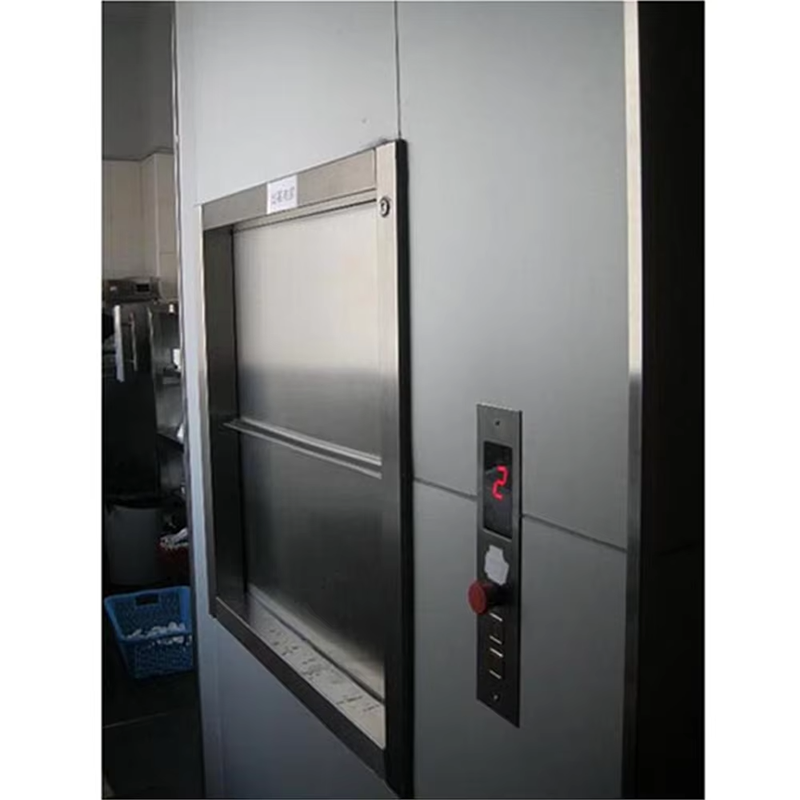
A food dumbwaiter lift is a small, motorized freight elevator designed specifically to transport food, beverages, crockery, and kitchen supplies between floors in commercial buildings. Unlike a full-sized passenger elevator, a dumbwaiter has a compact car — typically between 50 and 300 kilograms load capacity — and runs on a dedicated shaft or rail system with landing doors at each floor level.
The operational logic is straightforward: kitchen staff load trays or containers onto the dumbwaiter car at one floor, send it to the destination floor with a button press, and service staff unload at the other end. The cycle takes seconds rather than the minutes involved in stair transport. In a busy service environment — a hotel with a rooftop restaurant, a multi-floor dining venue, a hospital kitchen serving wards on different levels — the cumulative time saving across a full service period is substantial.
Beyond speed, food dumbwaiter lifts reduce physical strain on kitchen and service staff, lower the risk of accidents on stairs during peak service, and allow food to arrive at the service point in better condition — less disturbed, less cooled, and plated correctly rather than disrupted in transit.
Not all food service lifts are built the same way. The drive system, shaft configuration, and car size vary significantly depending on the installation environment and operational requirements.
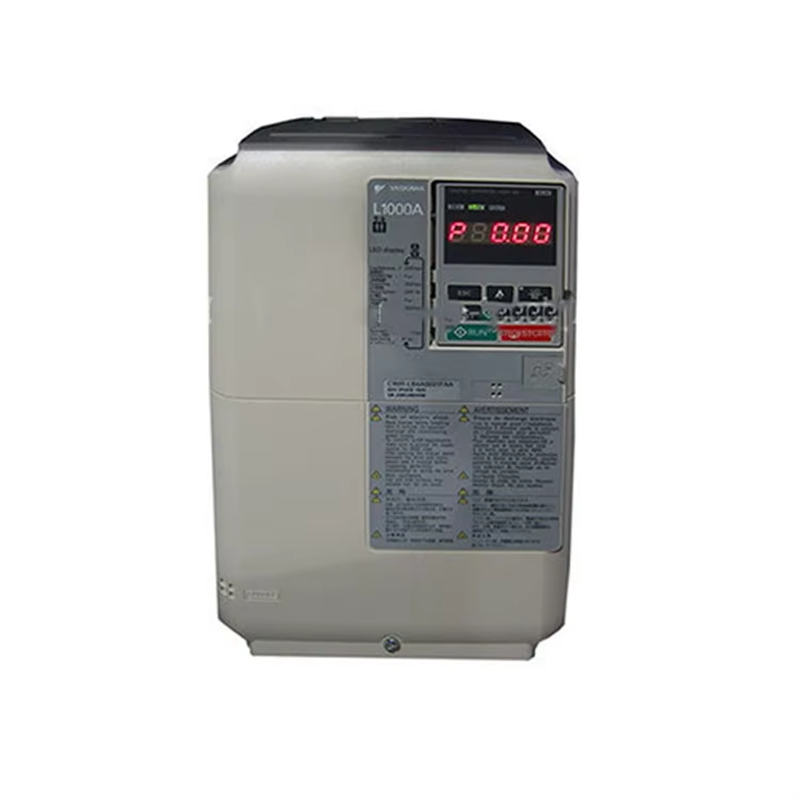
The most common type in commercial food service. An electric motor drives a traction system — either cable-and-counterweight or direct drum winding — that moves the car up and down the shaft. Electric dumbwaiter lifts for restaurants are smooth, quiet, and energy-efficient, and they can be configured for two, three, four, or more floors. Most modern units use variable frequency drives (VFDs) for controlled acceleration and deceleration, which reduces shock loading on the structure and makes operation noticeably quieter than older contactor-switched systems.
Hydraulic drive systems use a pump and cylinder arrangement to raise and lower the car. They are robust and well-suited to heavier loads but are less common in food service applications because they require a machine room for the hydraulic power unit, generate more heat, and are generally slower than traction systems for the same load rating. They are more typically found in industrial or laboratory dumbwaiter applications than in restaurant kitchens.
A smaller niche product that uses air pressure differentials to move a cylindrical car through a tube. Pneumatic dumbwaiters are compact and require no machine room or shaft construction, but their load and size capacity is limited — typically under 50 kg and restricted to small items. They are occasionally used in hospitality for document or small parcel transport but are not practical for full tray or multi-dish food service loads.
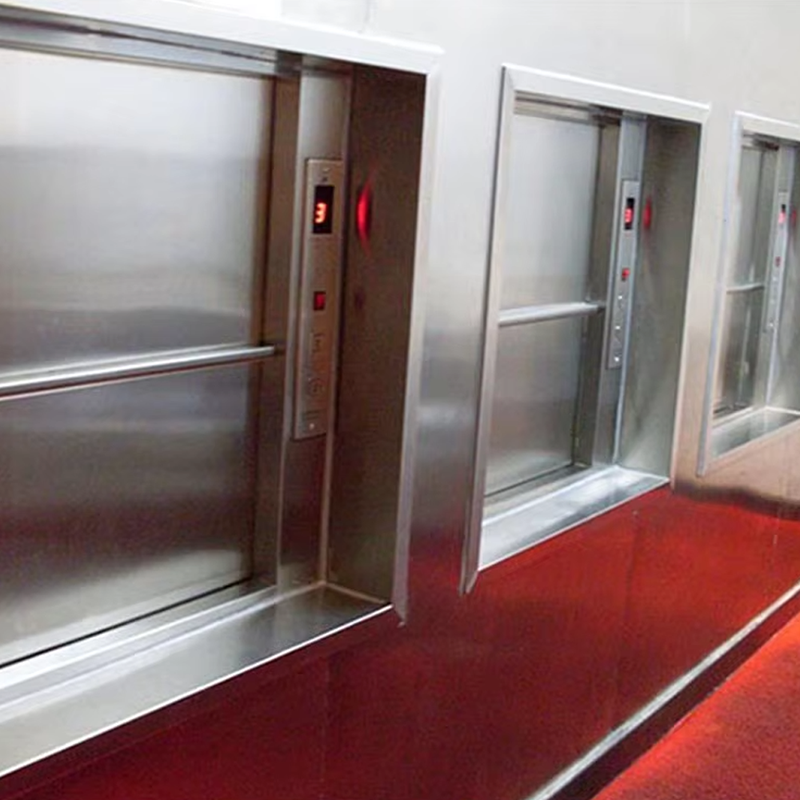
Some dumbwaiters are classified as general goods lifts and can handle a wide range of freight, while others are specifically engineered for food environments — with stainless steel car interiors, non-porous surfaces that meet food hygiene standards, and landing doors with positive sealing to prevent cross-contamination between kitchen and service areas. For any commercial kitchen application subject to food safety inspections, specifying a food-grade dumbwaiter rather than a generic goods lift is important for compliance.
When comparing food dumbwaiter lifts, these are the specifications that most directly affect whether the unit will perform reliably in your specific environment.
| Specification | Typical Range | What It Affects |
| Load Capacity | 50 – 300 kg | Number of trays or dishes per trip |
| Car Dimensions (W × D × H) | 400×400×400mm to 1000×800×1200mm | Tray size compatibility, shelving configuration |
| Travel Speed | 0.2 – 0.5 m/s | Cycle time per trip, throughput capacity |
| Number of Stops | 2 – 6 floors | Building coverage, installation complexity |
| Drive System | Traction / Hydraulic / Drum | Noise level, energy use, machine room requirement |
| Power Supply | Single or three-phase, 220V–380V | Electrical installation requirements |
| Door Type | Manual swing / Automatic sliding | Hygiene compliance, ease of use during service |
| Interior Material | Stainless steel / Painted steel | Food hygiene compliance, cleanability |
Load capacity is the first specification to fix. A realistic assessment of peak service demand — how many trays need to move per hour and how many trips per service the lift will realistically make — determines whether you need a 100 kg unit or a 250 kg unit. Undersizing the lift creates a bottleneck that negates the efficiency benefit of having it at all.
Car dimensions are closely tied to how you intend to load the lift. The two most common configurations in restaurant dumbwaiter lifts are shelf-based loading and trolley-based loading.
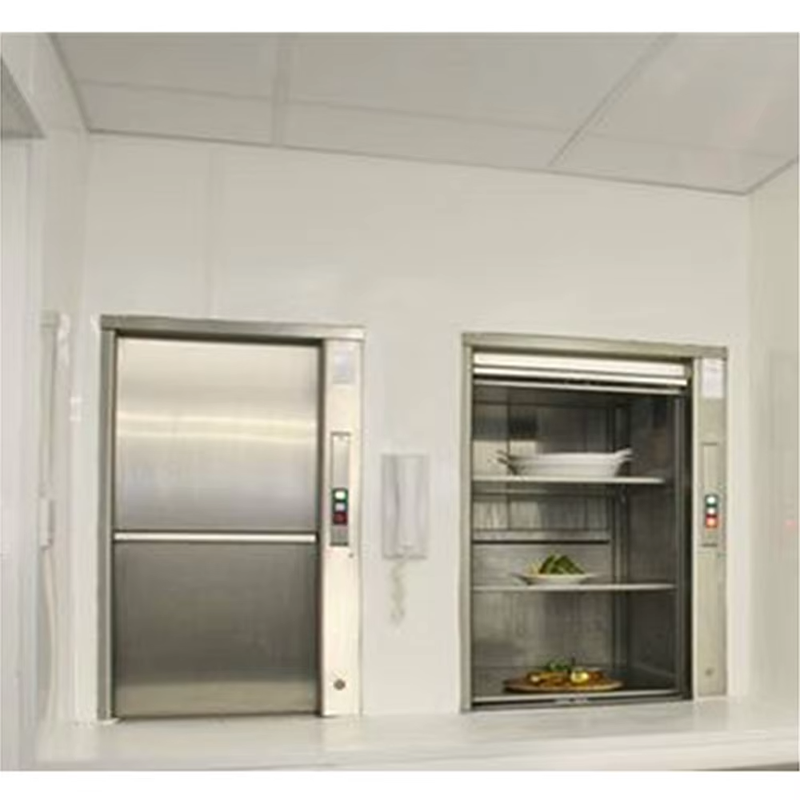
Shelf-based cars have fixed or adjustable horizontal shelves inside the car, typically spaced 250–350mm apart to accommodate standard GN (Gastronorm) trays or hotel pans. A car sized for three GN 1/1 trays side by side might have internal dimensions of approximately 700mm wide × 600mm deep × 900mm high — enough for a full table's worth of main courses in one trip. This configuration is most common in hotel room service, hospital food delivery, and banquet preparation kitchens.
Trolley-based configurations use a larger car — typically 800mm wide × 800mm deep or more — that allows a full catering trolley to roll in and out of the dumbwaiter car directly. This eliminates the manual transfer of trays between trolley and lift, saving additional time at both ends of the journey. It requires a larger shaft footprint and a higher car height, but for high-volume operations the throughput improvement is significant.
One specification that is frequently overlooked is door opening height. A car with adequate internal height is useless if the landing door opening is too low to load tall items. Always confirm the clear door opening dimensions, not just the car interior dimensions, when evaluating a food service lift.
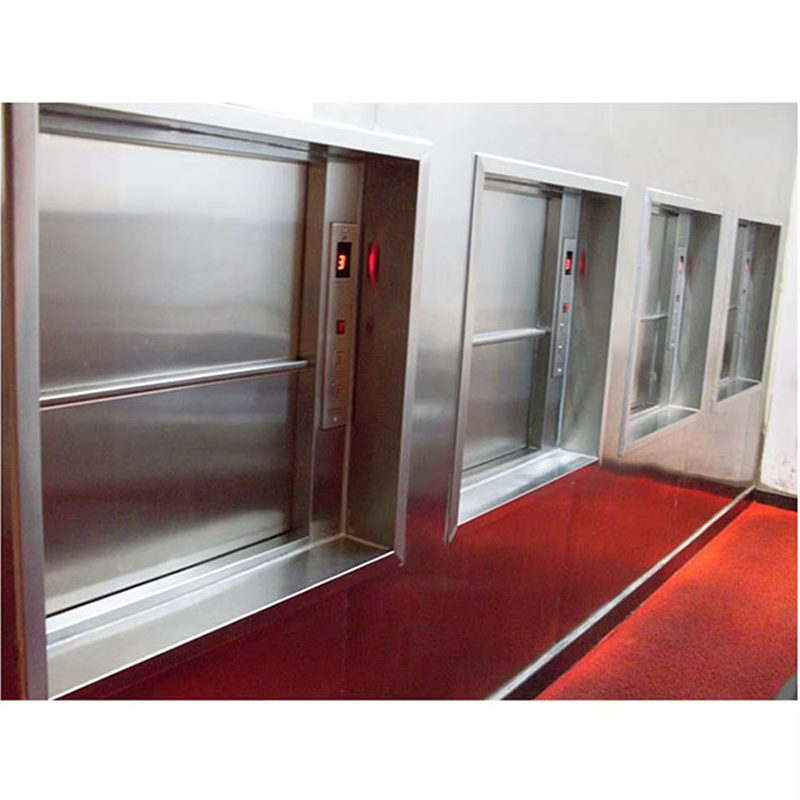
Installing a food dumbwaiter lift in an existing building is a more involved process than many buyers anticipate. Understanding the requirements upfront prevents budget surprises and scheduling disruptions.
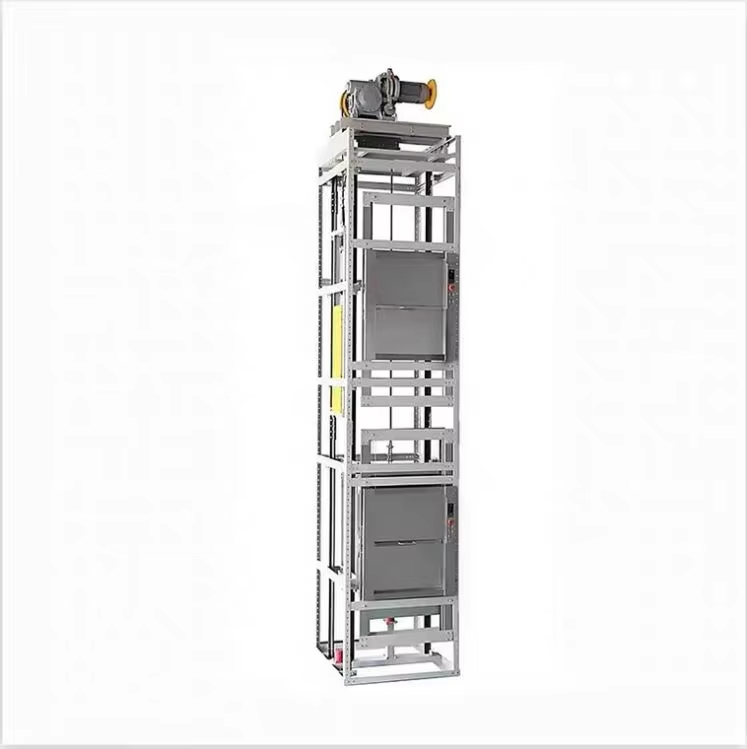
A dumbwaiter requires a dedicated shaft running vertically between floors. In new construction this is straightforward to plan, but in retrofit installations it typically requires cutting through floor slabs and constructing a masonry or steel-framed enclosure. The shaft must be structurally sound, plumb, and correctly dimensioned — the manufacturer will provide minimum shaft dimensions based on the car size and guide rail configuration. Shaft construction is usually the largest cost component of a retrofit installation and should be estimated separately from the dumbwaiter equipment cost itself.
Traditional traction and hydraulic dumbwaiters require a machine room — a dedicated space for the motor, controller, and drive equipment. In food service buildings where space is constrained, this is often a significant planning challenge. Many modern electric dumbwaiter lift systems are now available in machine-room-less (MRL) configurations, where the drive unit is mounted within the shaft or at the top landing, eliminating the need for a separate plant room. MRL systems have become the preferred specification for restaurant and hospitality installations for exactly this reason.
A dedicated electrical circuit is required for the dumbwaiter. Smaller units (under 100 kg, single-phase) can typically run on a 16A circuit from a standard commercial panel. Larger three-phase systems require a dedicated supply from the main distribution board, with the cable run sized for the motor's full load current plus a safety margin. This work must be carried out by a qualified electrician and in most jurisdictions requires inspection and certification.
In most countries, dumbwaiter lifts are classified as lifting equipment and are subject to specific regulatory requirements covering design, installation, and periodic inspection. In the UK, this falls under the Lifting Operations and Lifting Equipment Regulations (LOLER) and the Supply of Machinery (Safety) Regulations. In the EU, the Machinery Directive applies. In the US, ASME A17.1 covers small freight elevators and dumbwaiters. The installer should be able to provide all relevant certification documentation, and the completed installation should be inspected by a competent person before it enters service.
A food dumbwaiter lift in a commercial kitchen is a food contact environment and needs to be treated as one. Several design and specification choices directly affect whether the installation will pass a food safety inspection.
The applications below represent the highest-volume use cases for commercial kitchen dumbwaiters, and each has specific requirements worth noting.
| Application | Typical Configuration | Key Requirement |
| Multi-floor restaurant | 100–200 kg, 2–3 stops, shelf car | Fast cycle time, quiet operation |
| Hotel room service / banqueting | 150–300 kg, 3–6 stops, trolley-compatible | High throughput, trolley roll-in capability |
| Hospital / care facility kitchen | 100–250 kg, multi-stop, SS interior | Food hygiene certification, reliability |
| Bar / rooftop venue | 50–150 kg, 2 stops, compact car | Small shaft footprint, beverage-safe interior |
| School or institutional canteen | 100–200 kg, 2–3 stops | Durability, simple controls, low maintenance |
A correctly specified and installed electric dumbwaiter lift for restaurant use is a low-maintenance piece of equipment, but it is not maintenance-free. Understanding what a proper service program involves helps set realistic expectations and avoid unplanned downtime during service periods.
Most problems with dumbwaiter installations in food service environments come down to a small set of recurring specification and procurement errors.

Tel/wechat/whatsapp: +86-13812695057
E-mail: [email protected]
Add: Building 7, No. 268, Chang 'an Road, Bache Sub-district, Dong Taihu Ecological Tourist Resort (Taihu New Town), Wujiang District, Suzhou City, Jiangsu Province, China