

 English
 Español
Home / News / Industry News / Hospital Elevators: What Makes Them Different, How to Spec Them Right, and Why It Matters for Patient Care
Industry News

Tel/wechat/whatsapp: +86-13812695057
E-mail: [email protected]
Content
A hospital elevator is not simply a larger or more durable version of a commercial passenger elevator — it is a purpose-engineered vertical transportation system designed around the specific operational, clinical, and infection control demands of healthcare environments. Where a standard commercial elevator needs to move people comfortably between office floors, a hospital elevator must simultaneously accommodate stretchers, hospital beds, medical equipment trolleys, clinical staff, visiting family members, and in some configurations clean and soiled material flows that must remain segregated for infection control reasons. These requirements combine into a performance specification that is fundamentally different from any other elevator application.
The consequences of elevator failure in a hospital are immediate and serious in a way they are not in most other building types. A delayed surgery patient, an interrupted emergency response, or a breakdown that traps a bed-bound patient in a car between floors creates clinical risk that no other building system failure replicates with the same immediacy. This is why hospital elevator specifications go well beyond physical dimensions — they cover redundancy, priority control systems, emergency power integration, infection-resistant surface materials, vibration limits, and noise levels that would not appear in any commercial elevator specification.
Understanding what makes a hospital elevator genuinely fit for healthcare service — and what the gaps look like when the wrong equipment is specified or an existing installation ages without adequate maintenance — is essential knowledge for healthcare facility managers, hospital architects, and the clinical staff who depend on these systems every working day.
A well-designed hospital vertical transportation system includes several distinct elevator types, each optimized for a specific function and user group. Combining all hospital traffic — patients, visitors, clinical staff, beds, food, waste, and supplies — into a single elevator type creates queuing delays, infection control conflicts, and operational inefficiencies that compound across the working day. Most hospitals above a certain size separate their vertical circulation into at least three functional categories.
The patient elevator — also called a hospital bed elevator or stretcher elevator — is the most demanding specification in any hospital elevator program. It must accommodate a fully extended hospital bed with attached IV poles, monitoring equipment, and accompanying clinical staff on both sides of the bed, typically requiring a minimum interior depth of 2,400mm and a door clear opening width of at least 1,800mm. In larger hospitals and those performing high volumes of intensive care transfers, interior depths of 2,700–3,000mm are specified to allow two clinical staff members to work alongside the bed during transport without being compressed against the cab walls. The car must level precisely at each floor — within ±6mm of the landing — to allow smooth bed transfer over the threshold without jarring the patient or catching the bed wheels on any sill gap.
Ride quality is a clinical requirement in patient elevators, not merely a comfort preference. Patients with spinal injuries, post-surgical conditions, or fragile physiological states can experience pain or clinical deterioration from vibration or sudden acceleration changes during elevator travel. Hospital bed elevator specifications typically include vibration limits of less than 15 mg (peak-to-peak) during travel and acceleration profiles that limit jerk — the rate of change of acceleration — to values well below those acceptable in commercial elevators. This requirement directly constrains the drive system selection and often mandates gearless permanent magnet traction machines with sophisticated variable-voltage variable-frequency (VVVF) control systems that provide smooth, precisely controlled motion across the full speed range.
Clinical staff elevators serve the high-frequency movement of doctors, nurses, and allied health professionals between clinical floors and departments. In busy teaching hospitals and tertiary referral centers, clinical staff may make dozens of floor transitions per shift, and waiting time for an elevator is a genuine productivity and patient care issue. Clinical elevators are specified for rapid response — door-to-door travel times and call response times measured in seconds rather than minutes — and for interior configurations that allow efficient loading by groups of staff, equipment, and supplies without the extreme interior depth requirements of bed elevators. They are typically used alongside staff access systems that prioritize clinical staff calls over visitor calls during peak clinical hours.
Hospital service elevators handle the building's material flows — food service trolleys, linen and laundry, pharmacy supply carts, sterile supply, medical equipment, and waste streams including clinical waste, soiled linen, and pathology specimens. In many hospitals, infection control protocols require that clean and soiled material flows are handled in completely separate elevator shafts with no shared use, preventing cross-contamination between incoming clean supplies and outgoing waste and soiled materials. Service elevators are built to freight elevator structural standards — hardened floor surfaces, impact-resistant cab interiors, and door systems rated for cart and trolley impact — but must also meet the surface hygiene requirements of the healthcare environment, with stainless steel finishes, sealed joints, and coved junctions that allow high-level cleaning and disinfection.
Visitor elevators serve the general public accessing the hospital — patients arriving for outpatient appointments, visitors to inpatient wards, and general building users. They are designed to the aesthetic and functional standards of high-quality commercial elevators, with accessible features for disabled users, intuitive controls, and interior finishes that project a reassuring and professional healthcare environment. They must be physically and operationally separated from clinical and service circulation to prevent visitors from inadvertently entering clinical areas, and are typically located in the public atrium or main entry zones of the hospital rather than in the clinical core.
Dimensional adequacy is perhaps the most visible and most frequently misspecified aspect of hospital elevator design. Undersized elevators are a permanent operational constraint — once the building is constructed, the shaft dimensions cannot be changed without major structural intervention — and the consequences of undersizing manifest as daily operational inefficiencies and patient care compromises that persist for the building's entire 30–50 year service life.
| Elevator Type | Min. Interior Width | Min. Interior Depth | Min. Door Clear Width | Rated Load |
|---|---|---|---|---|
| Patient / Bed Elevator | 2,000–2,400 mm | 2,400–3,000 mm | 1,800 mm | 2,000–3,200 kg |
| Clinical Staff Elevator | 1,400–1,800 mm | 1,600–2,000 mm | 1,100 mm | 1,000–1,600 kg |
| Service / Materials Elevator | 2,000–2,500 mm | 2,500–3,500 mm | 1,800–2,200 mm | 2,000–5,000 kg |
| Visitor / Public Elevator | 1,200–1,600 mm | 1,400–1,800 mm | 900–1,100 mm | 630–1,000 kg |
The depth dimension of the bed elevator is the most frequently undersized parameter in hospital projects where design teams unfamiliar with clinical workflows apply standard commercial elevator dimensions. A standard hospital bed with raised side rails and a patient connected to a volumetric infusion pump and portable cardiac monitor requires approximately 2,300mm of floor length. Add the 200–300mm of clinical equipment and pole extensions beyond the bed ends, and the practical minimum car depth for safe bed transport with one attendant is 2,600mm. Adding a second clinical staff member — standard practice for critically ill patient transfers — raises the practical minimum to 2,800mm. Projects that specify 2,100mm bed elevator depth based on code minimima rather than clinical workflow analysis consistently report operational problems from day one of opening.
Infection control in hospital elevator cars is not a cosmetic consideration — it is a patient safety requirement that affects material specification, joint design, cleaning protocol compatibility, and the selection of every surface element inside the car. Hospital-acquired infections (HAIs) represent one of the largest preventable causes of patient harm in healthcare systems worldwide, and high-touch surfaces in frequently used spaces — elevator car walls, handrails, door edges, and control panels — are recognized transmission vectors for pathogens including MRSA, Clostridioides difficile, and multidrug-resistant Gram-negative bacteria.
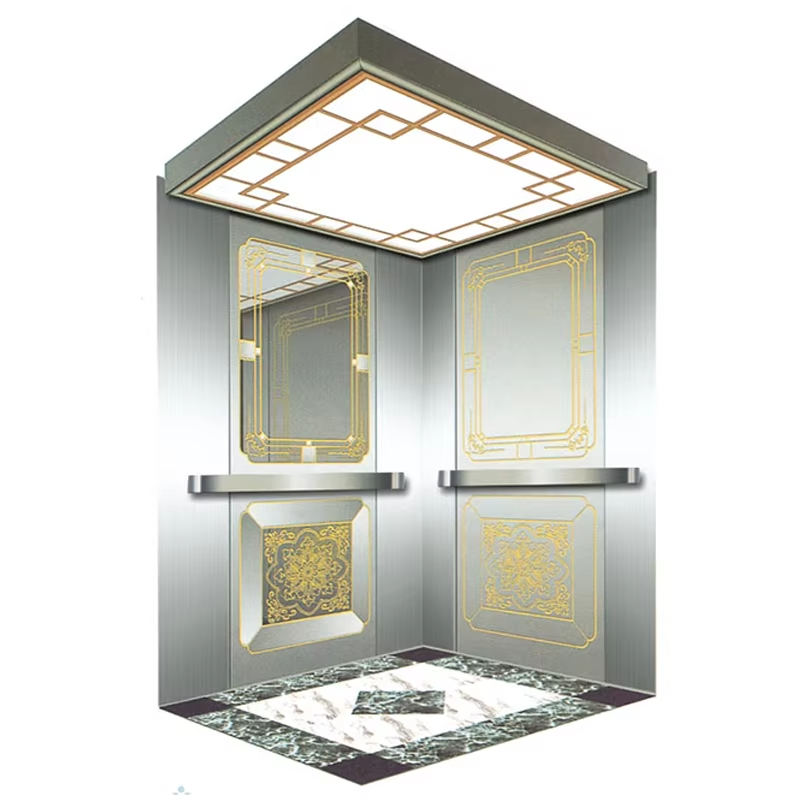
Hospital elevator car interiors require surfaces that are non-porous, seamless where possible, and compatible with the full range of disinfectants used in healthcare cleaning programs — including quaternary ammonium compounds, hydrogen peroxide solutions, and hypochlorite-based disinfectants that would rapidly degrade the painted or laminated surfaces standard in commercial elevator interiors. Grade 316L stainless steel wall panels with a No. 4 brushed finish are the dominant specification for patient and clinical elevator interiors, providing chemical resistance, ease of visual soil detection, and surface durability against impact from beds and equipment. Powder-coated steel panels, phenolic resin panels, and solid-surface composite panels are also used depending on the hospital's cleaning protocol and aesthetic requirements, but must be specified with documented disinfectant compatibility data.
All panel joints, cove junctions at wall-to-floor transitions, and fixture penetrations must be fully sealed to eliminate crevices where organic material and microorganisms can accumulate. The standard healthcare interior design requirement for coved junctions — a curved rather than right-angle transition between wall and floor surfaces — must be carried into the elevator car design to maintain the cleaning standard consistent with the surrounding corridor and room environments. Square-section wall-to-floor junctions that are standard in commercial elevators are specifically excluded from healthcare elevator specifications for this reason.
Hospital elevator car floors face a combination of demands that make flooring selection more complex than in any other elevator application: they must be slip-resistant when wet (from spilled clinical fluids or cleaning solution), durable under heavy wheeled loads from beds and trolleys, chemically resistant to healthcare disinfectants, and visually clean-looking to project the hygiene standards patients and visitors associate with quality healthcare. Homogeneous vinyl sheet flooring heat-welded at seams to create a joint-free surface is the most widely used specification, offering the combination of slip resistance, chemical resistance, cleanability, and wheeled load performance needed. Rubber flooring with anti-static properties is specified in areas adjacent to MRI suites and locations with high electrical equipment use. Tile formats — ceramic or luxury vinyl tile — are avoided in hospital elevator cars because grout joints and tile edges create crevices and wear points that compromise cleanability and durability under hospital loading conditions.
Hospital elevator handrails serve both a patient safety function — providing a grip support for ambulatory patients and visitors — and a contamination control challenge, as handrails are among the highest-contact surfaces in the car. Stainless steel tubular handrails with smooth, continuous profiles and no exposed fixings or crevices at mounting brackets are the hygienic standard. Some hospitals now specify antimicrobial copper alloy handrails, which have demonstrated surface kill rates of greater than 99.9% for key healthcare pathogens within two hours of contamination — a clinical advantage over stainless steel, which retains surface viability for extended periods. Control panels in hospital elevators require a design that allows complete surface disinfection — no recessed keyholes, no exposed screw threads, and no gaps between the control panel face and the surrounding wall panel where cleaning solution and organic material can accumulate.
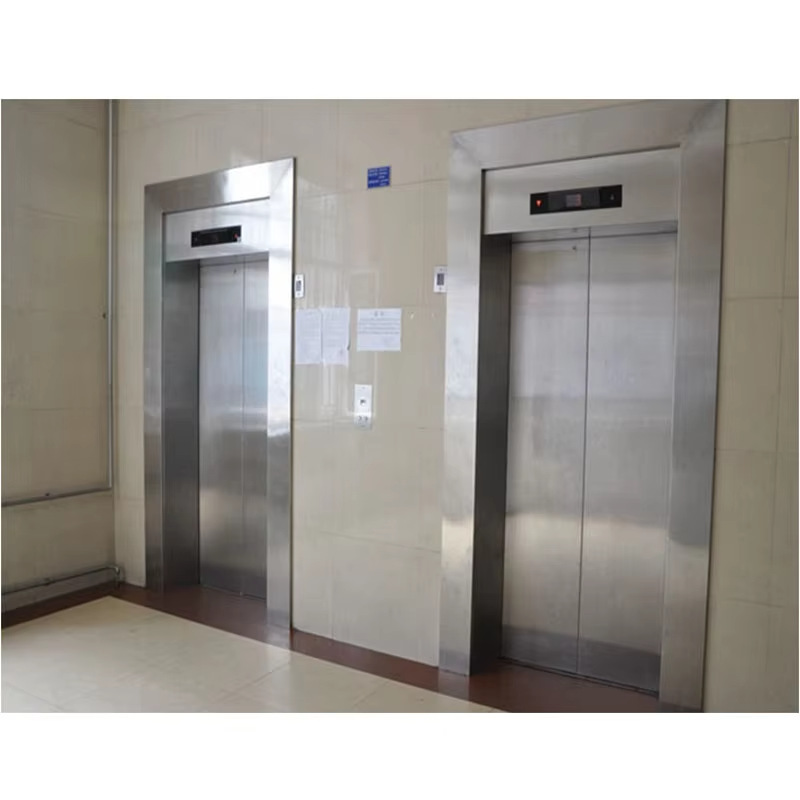
Hospital elevator control systems go significantly beyond the standard call-and-dispatch logic of commercial elevator systems. Healthcare facilities have complex, time-variable priority hierarchies — emergency situations that require immediate elevator availability, clinical workflows that require predictable response times, and routine transport patterns that can be anticipated and managed by the dispatch system to reduce wait times. The control system must serve all of these simultaneously while integrating with the hospital's emergency power infrastructure to ensure elevator availability during mains power failure events.
Hospital elevators are equipped with key-switch or card-reader operated priority controls that allow clinical staff to commandeer an elevator for immediate exclusive use — returning it to the nearest landing, holding the doors open while equipment or a patient is loaded, and sending it directly to the required floor without intermediate stops. Code blue (cardiac arrest) priority systems automatically direct designated elevators to the floor of a cardiac emergency and hold them available for the resuscitation team. Surgical emergency priority operates similarly for the operating theater floors. These overriding control modes are integrated with the hospital's nurse call and emergency alert systems so that the elevator response is automatic when the alert is triggered, without requiring manual action at the elevator control panel.
Hospital elevators must remain operational — or return to service rapidly — during mains power failures. The standard approach connects designated hospital elevators to the facility's emergency generator system, which must restore power to these elevators within 10 seconds of mains failure under most healthcare building codes. During the generator start-up period before power is restored, patients in elevator cars must be protected from being stranded between floors — this is achieved through Automatic Rescue Devices (ARDs) that use a battery backup system to drive the car at reduced speed to the nearest floor landing, level it precisely, and open the doors so occupants can exit safely. ARDs are a mandatory requirement in hospital elevator specifications in most jurisdictions and must be tested at regular intervals as part of the elevator maintenance program to verify that the battery is charged and the drive system functions correctly under backup power.
The number of hospital elevators connected to emergency power is a critical planning decision. Connecting all elevators to emergency power is rarely feasible — generator capacity constraints limit the load that can be sustained. Standard practice designates a minimum number of elevators per elevator bank to remain operational on emergency power, chosen to maintain essential clinical workflows including patient transport, emergency response, and critical supply distribution during the power failure period. The remaining elevators are connected to emergency power for ARD operation only — they can return patients to a floor and open doors, but cannot resume normal service until mains power is restored.
The acoustic and vibration performance of a hospital elevator is a clinical specification, not simply a quality-of-life consideration. Patients being transported in hospital beds may include post-surgical patients with wound pain, patients with fractures or spinal injuries, neonates and premature infants in incubators, and critically ill patients whose physiological stability is sensitive to mechanical disturbance. The elevator car's noise level, vibration amplitude during travel, and acceleration and deceleration profile during floor-to-floor trips all directly affect patient comfort and, in the most sensitive cases, patient safety.
Hospital elevator noise specifications typically limit in-car sound pressure levels to 55 dB(A) or lower during travel — significantly quieter than commercial elevators, which may operate at 60–65 dB(A) in the car. This requirement drives the selection of gearless traction machines over geared machines, as geared machines produce a characteristic gear mesh noise that is difficult to reduce below 58–60 dB(A) even with acoustic enclosures. It also requires attention to guide shoe design and rail lubrication — worn guide shoes or dry rails produce a rhythmic rumble during travel that is highly noticeable in the quiet conditions of a hospital. Vibration limits of 10–15 mg peak-to-peak during travel are typical for hospital bed elevator specifications, requiring VVVF drive systems with vibration feedback compensation and regular guide rail straightness surveys to ensure the ride quality is maintained throughout the elevator's service life.
The acceleration profile — how quickly the elevator reaches its travel speed and how smoothly it decelerates to a stop — is controlled by the drive system's motion profile programming. Hospital elevator specifications typically limit acceleration to 0.8–1.0 m/s² and jerk (rate of change of acceleration) to 1.0–1.5 m/s³, compared to commercial elevators that may operate at 1.2 m/s² acceleration and higher jerk rates for faster traffic handling. The softer acceleration profile increases the time per trip slightly, but this is an acceptable trade-off for the clinical requirement to avoid jerking or jolting a patient during transport.
Hospital elevator reliability has a different meaning from reliability in a commercial building. In an office tower, an elevator out of service for scheduled maintenance creates inconvenience and potential productivity loss. In a hospital, an elevator out of service during a clinical emergency, during a scheduled surgery, or during a mass casualty event creates direct patient care risk that cannot be mitigated simply by using the stairs. Hospital elevator maintenance programs must therefore be structured to minimize unplanned downtime, guarantee rapid response when unplanned failures do occur, and schedule preventive maintenance during periods of lowest clinical demand — typically overnight or on weekends for the most critical elevators.
Horizontal redundancy — having multiple elevators in each functional category so that the failure of any single unit does not eliminate the clinical function — is the fundamental resilience strategy for hospital elevator systems. The number of elevators in each bank is determined by traffic analysis that establishes the minimum number needed to handle peak clinical demand, with additional units providing operational redundancy above that minimum. In practice, hospital elevator groups are sized so that loss of any single elevator leaves the remaining units able to handle 100% of normal demand at an acceptable level of service — defined by wait time and trip time targets that clinical operations staff and facility managers agree on at the design stage.
Modern hospital elevator installations increasingly incorporate remote condition monitoring systems that transmit real-time operational data — door cycle counts, motor current, brake wear indicators, leveling accuracy, and fault log data — to the elevator service provider's monitoring center. This data enables predictive maintenance interventions that replace failed components before breakdown occurs, rather than responding to failures after they have already interrupted hospital operations. For example, monitoring door operator motor current trends can identify a developing door mechanism friction issue three to four weeks before it would cause a door fault — allowing a maintenance visit to be scheduled at a convenient time rather than responding to an emergency call with an elevator stopped at a random floor with a trapped patient or blocked transport route.
Many hospitals operate elevator systems that were installed 20, 30, or even 40 years ago — equipment that was well-designed for the healthcare environment of its era but that falls significantly short of current clinical, infection control, and energy performance standards. Recognizing when an aging hospital elevator has reached the point where modernization delivers better value than continued maintenance of the original equipment is one of the most important capital planning decisions a healthcare facility manager makes.
Elevator modernization in a hospital context ranges from targeted component upgrades — replacing a geared machine with a gearless drive system, upgrading relay logic controls to a modern microprocessor controller, or retrofitting a new door operator — to complete car refurbishment that replaces all interior finishes with materials meeting current infection control standards, while retaining the existing hoistway structure and safety systems. Full refurbishment to current clinical standards typically costs 30–50% of the cost of a new elevator installation, delivers a car that meets current hygiene, accessibility, and performance specifications, and extends the serviceable life of the installation by 15–20 years — making it the most common and cost-effective modernization approach for hospitals where the original shaft dimensions are adequate for current clinical needs.
When an existing elevator's shaft dimensions are themselves the problem — because clinical workflows have evolved to require bed sizes or equipment configurations that the original car cannot accommodate — full replacement including shaft widening is the only solution, and this typically requires a major construction project with significant disruption to the adjacent clinical areas. Planning for this scale of work requires detailed clinical impact assessment, phased construction sequencing that maintains minimum elevator service throughout the project, and lead times of 12–24 months from project approval to completion. The cost and disruption of this scenario makes the case powerfully for getting hospital elevator dimensions right at the initial design stage — the lifetime cost of an undersized shaft far exceeds the marginal cost of specifying a larger shaft during original construction.

Tel/wechat/whatsapp: +86-13812695057
E-mail: [email protected]
Add: Building 7, No. 268, Chang 'an Road, Bache Sub-district, Dong Taihu Ecological Tourist Resort (Taihu New Town), Wujiang District, Suzhou City, Jiangsu Province, China