

 English
 Español
Home / News / Industry News / Anchor Bolt Guide: Types, Load Requirements, and Selection for Elevator Installations
Industry News

Tel/wechat/whatsapp: +86-13812695057
E-mail: [email protected]
A guide rail that flexes even a few millimeters under load will never produce a smooth ride. In elevator shaft work, that rail stays fixed to the wall through a series of brackets, and each bracket is secured with anchor bolts. The load path runs from the rail, through the bracket, and into the concrete, so the anchor bolt is the point where shaft structure, rail geometry, and daily traffic all meet. The practical rule for anyone planning a new installation or a replacement is simple: the concrete and the bolt must work together, or the rail will eventually move.
An anchor bolt on an elevator guide rail is not a free-floating fastener; it is the transfer point for both static and dynamic loads. Static loads come from the weight of the rail itself and the bracket hardware. Dynamic loads come from the carriage passing: guide shoes push against the rail, and that push is transmitted into the wall. A 630 kg passenger elevator at full load can create lateral forces at the guide shoes that far exceed the weight of the rail system alone. That is why codes and manufacturers publish specific spacing for rail brackets, usually every 1.5 to 2.5 meters depending on the building height and the rail profile.
Two parameters control whether the anchor does its job: concrete pullout strength and bolt torque. The concrete around the bolt must be dense enough to resist the expansion mechanism. The bolt must then be tightened to the specified torque, because an under-torqued expansion anchor does not develop its rated capacity. If you are reviewing a guide rail system, the guide rail types, standards, and installation criteria are the counterpart to the anchor choice. Most ride quality complaints can be traced to one side or the other.
Anchor type follows the construction phase. In a new building with open shafts, cast-in-place bolts are the preferred approach. In retrofit or modernization work, post-installed anchors are almost always the answer because the fastener has to be set after the wall has already cured.
These are set into the formwork before the concrete is poured. The steel rod is welded to the form or held in position, and the pour locks the head into the concrete. Because the concrete bonds directly to the bolt, cast-in anchors give the strongest pullout resistance and the least deflection under load. The tradeoff is positioning tolerance: bracket holes need to line up with the bolt locations, and any mismatch has to be handled with slotted brackets or shims.
Post-installed expansion anchors are the workhorse of elevator modernization. The bolt is inserted into a drilled hole, and as you torque the nut, the sleeve or wedge expands against the concrete. In shafts, expansion bolts are commonly used with rail brackets. The design checks that matter are concrete edge distance and spacing between bolts: expanding wedges create a stress cone in the concrete, and when two cones overlap, the combined capacity drops.
A bonded anchor uses an adhesive to fix the rod into the drilled hole. Bonded anchors are useful in cracked concrete or where the shaft wall quality is uncertain, because the adhesive distributes the load along the hole instead of concentrating it at the base. They also hold up better under vibration. The drawback is installation time: the hole has to be cleaned, the resin injected, and the adhesive cured before final torque.
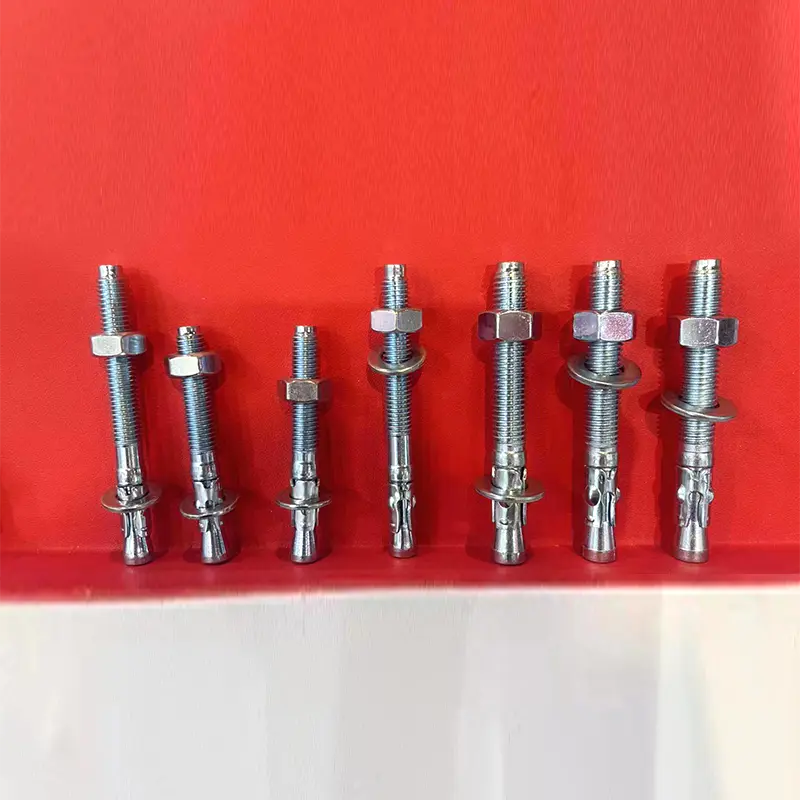
The selection process starts with loads. Note the total weight of the rail, the bracket spacing, and the maximum lateral force acting on the guide shoe. That force becomes the design pullout load for the anchor. Then check the concrete: a typical shaft wall in a concrete building is 200 to 300 mm thick with a compressive strength of 20 to 40 MPa. Do not match a bolt rated for 5 kN to a 12 kN bracket load only because the bolt diameter fits the hole. Diameter and grade are two separate decisions.
| Anchor Type | Typical Pullout Range | Concrete Condition | Installation Time | Adjustment After Set |
|---|---|---|---|---|
| Cast-in-place | 20 to 50 kN per bolt | Forming in place | Poured with wall | Limited, use slotted bracket |
| Mechanical expansion | 5 to 25 kN per bolt | Solid, uncracked | 5 to 10 minutes per bolt | Moderate |
| Bonded | 10 to 40 kN per bolt | Cracked or uncertain | 15 to 30 minutes per bolt | Low |
Once the loads are known, the anchor type can be matched to the concrete condition and the expected ceiling for installation time.
Most anchor failures in elevator shafts are not material failures; they are installation errors. The three most common problems are:
Any of these will show up as a loose bracket, a rail that cannot be straightened, or a guide shoe that wears unevenly. In a modernization project, checking the existing anchor torques is often the cheapest way to improve ride quality without changing the rail itself.
When you buy anchor bolts for an elevator shaft, confirm the material first. Zinc-plated carbon steel is the norm in dry interior shafts; stainless steel becomes necessary in outdoor, humid, or chemical exposure environments. Next, check thread fit: a clean, consistent thread ensures the nut can be torqued accurately without binding. Product grade matters too because a 6.8 grade bolt and an 8.8 grade bolt have quite different yield strengths, and the supplier should be able to trace the batch.
Since anchor bolts are the hidden link between the rail system and the building, a small procurement mistake can create a lasting vibration or alignment problem. Ordering from a parts supplier that understands elevator shaft tolerances helps avoid surprises at the job site. Anchor bolts for elevator guide rails are available in several sizes, and it is worth checking the drawing against the actual rail bracket design before placing the order.
Anchor bolts are rarely the first component anyone looks at during an elevator project, but they control how well the rail system performs for decades. When you select the anchor type with the concrete condition in mind, torque it to the manufacturer's specification, and verify the material grade before ordering, you remove the most common causes of bracket looseness and rail misalignment.

Tel/wechat/whatsapp: +86-13812695057
E-mail: [email protected]
Add: Building 7, No. 268, Chang 'an Road, Bache Sub-district, Dong Taihu Ecological Tourist Resort (Taihu New Town), Wujiang District, Suzhou City, Jiangsu Province, China