

 English
 Español
Home / News / Industry News / Counterweight Block Guide: Types, Materials and How to Choose the Right One
Industry News

Tel/wechat/whatsapp: +86-13812695057
E-mail: [email protected]
Content
Open a machine room door, or shine a torch up a lift shaft, and you will notice it straight away: a stack of heavy rectangular blocks clamped inside a steel frame, sliding quietly on its own pair of guide rails. That assembly is the counterweight, and the blocks inside it are what make a traction elevator practical. Our team has supplied these unglamorous but essential parts to elevator factories, installers and modernization crews for years, and the questions we hear are always similar. Which material should it be? How much should the whole assembly weigh? How many pieces fit into one frame? This guide answers those questions in plain language.
In a traction elevator, the car and the counterweight hang from opposite ends of the same set of hoisting ropes, running over the traction sheave. The counterweight offsets the weight of the empty car plus roughly forty to fifty percent of the rated load. Because the two sides are nearly balanced, the motor only has to move the difference between them instead of lifting the full weight of a loaded car each time.
The blocks provide the mass that makes this possible. A counterweight frame on its own is just a steel skeleton, so it is filled with a calculated number of blocks, made of cast iron, concrete, steel plate or a composite filler, until it reaches the design weight. Engineers often call them counterweight blocks, filler weights, balance weights or sub-weights, but they all do the same job.
Two details matter more than most people expect. First, the total weight is not a rough figure; it is calculated from car weight, rated load, rope weight and the balance coefficient chosen for that building. Second, the blocks must be clamped firmly, because a loose filler weight will rattle, shift and eventually distort the frame.
Because the counterweight carries so much of the load, its condition affects the whole installation rather than just the shaft wall behind it.
In other words, a counterweight block is not simply dead weight. It is a tuned part of the drive and safety system, which is why swapping blocks for a random substitute is never a good idea.
Most blocks on the market fall into four families. The right one depends on the space inside the frame, the weight required per piece and the way the lift will be used.
| Material | Typical weight per block | Main strengths | Fits best with |
|---|---|---|---|
| Cast iron | Heavy for its size | Dense, stable, stacks precisely, resists deformation | Machine-room-less lifts and frames with limited space |
| Concrete | Moderate | Low cost, simple production, good for large mass | Standard passenger lifts, freight lifts, large frames |
| Steel plate | Heavy, thin profile | Compact, clean finish, easy to bolt in place | Retrofits and tight installation tolerances |
| Composite filler | Varies by shape | Custom weight, quiet running, corrosion resistant | OEM programmes and special project designs |
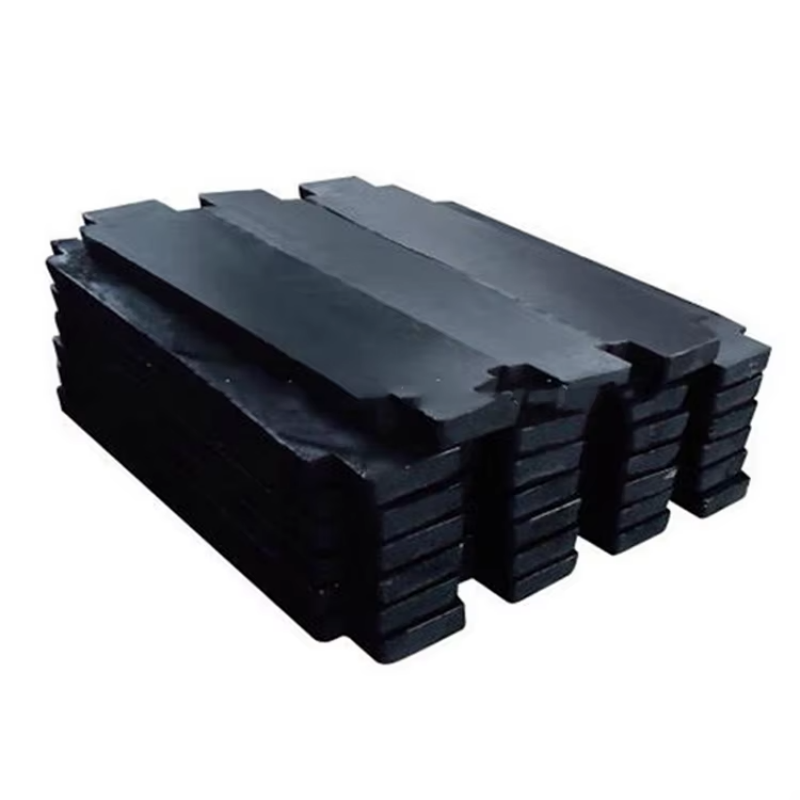 VTSP171 Elevator Concrete Blocks for Counterweight FramesCustomizable concrete counterweight blocks for elevator frames, worth reviewing when frame space and weight requirements suit concrete rather than denser alternatives.View Product →
Density is the main difference between these options. Cast iron is roughly three times denser than plain concrete, so the same mass takes up far less room in the frame. That is why compact machine-room-less designs tend to favour cast iron or steel plate, while larger machine-room lifts can use concrete blocks without any difficulty at all.
These are the classic rectangular blocks that slot into a steel frame from the bottom upwards. They are inexpensive and forgiving, and they are usually the default choice for machine-room lifts where space is not tight.
Cast blocks and machined sub-weights pack far more mass into the same footprint, which makes them popular where the frame is shallow or the balance coefficient demands a lot of weight in a small volume. They are also widely used as retrofit weights when a modernized lift needs more mass without a new frame.
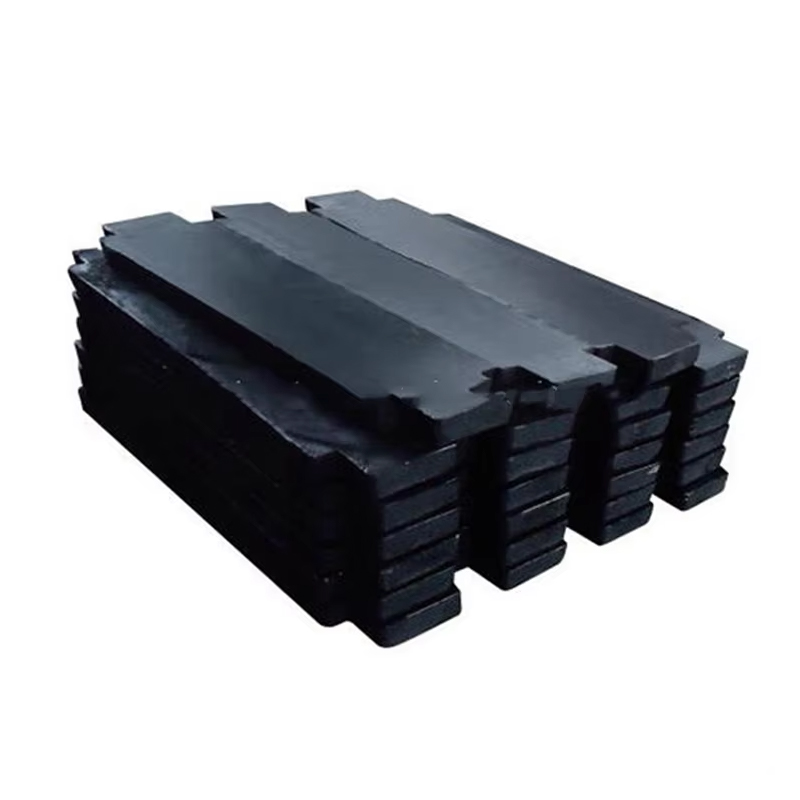 VTSP179 Cast Iron Elevator Balance Counterweight BlockCustom cast iron balance counterweight block for elevator systems, useful where more mass is needed within a shallow counterweight frame.View Product →
When a project needs the whole package rather than loose weights, blocks, clamps and the frame itself can be supplied together so that the finished assembly arrives at the correct design weight.
Before ordering, work through these points with the project engineer:
A small error here is not harmless. Overfilling shifts the balance point, while underfilling makes the machine work harder than it was sized for.
Fitting counterweight blocks is straightforward work, but it is easy to do badly.
While you are up there, it is worth checking the rest of the assembly at the same time, particularly the counterweight sheave and deflection pulley, since groove wear on those parts slowly changes how the ropes behave.
Older lifts make up a large share of this business. When a building modernizes its elevator, the block set is often reused, but pieces do get lost, broken or replaced with the wrong item over the years. Rebuilding the correct weight is usually cheaper and faster than replacing the frame.
For installers and maintenance companies, the practical answer is to record the block material, dimensions and quantity of each unit when you first service it, so a future replacement order can be placed in a single message. For elevator manufacturers, the same parts can be produced to drawing, in a preferred material, with the weight tolerance that the design requires.
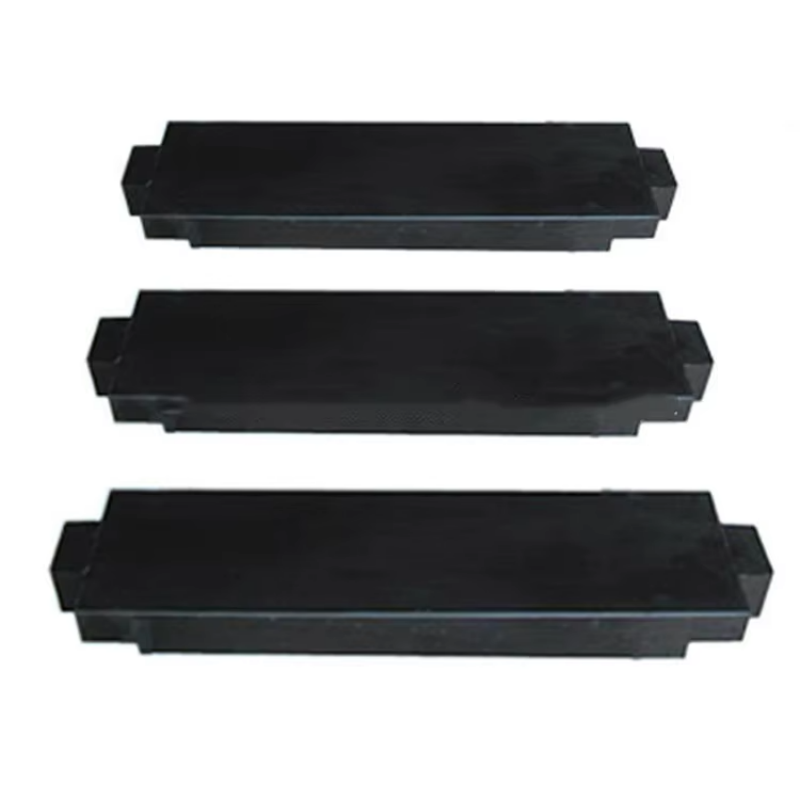 VTSP172 Custom Steel Plate Lift Counterweight BlockCustom steel plate counterweight block for lift balance systems, relevant when matching replacement parts or producing blocks to project drawings.View Product →
If you are sourcing for a modernization project or your own production line, you can review our range of counterweight blocks together with the matching frames, guide shoes and sheaves, so the whole balance side of the shaft arrives as one coordinated set.
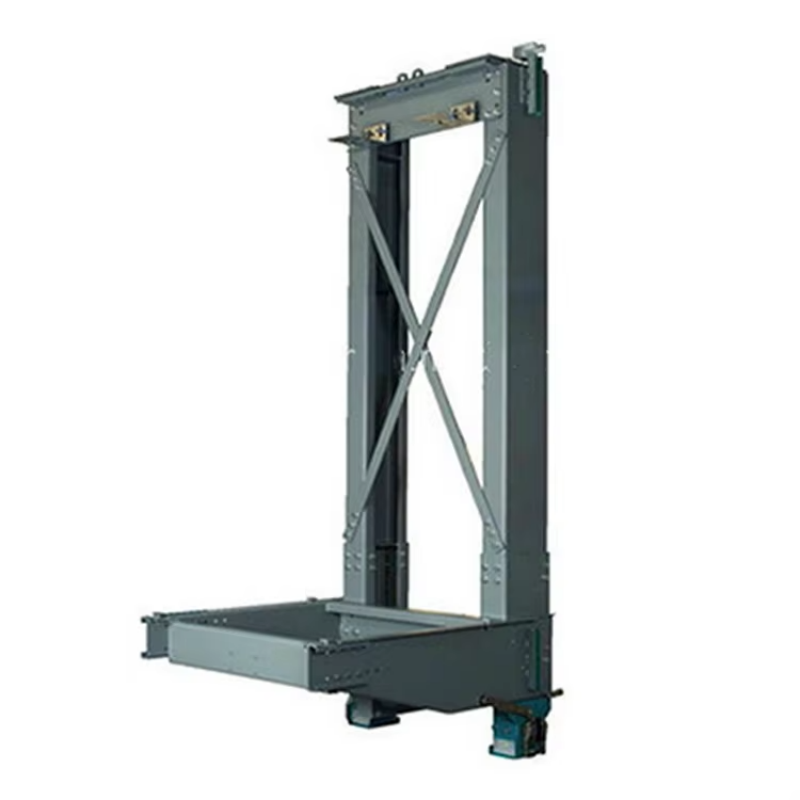
The frame is the steel structure that travels on the guide rails. The blocks are the weights clamped inside it, and together they form the counterweight assembly.
Use the design balance coefficient and rated load from the elevator documentation. If those papers are missing, a lift engineer can measure the car weight and recalculate the target mass.
Not often, but cast iron can corrode and concrete can crumble after long exposure to damp shafts. Any block that has cracked, lost mass or no longer clamps securely should be replaced with a matching item.
Counterweight blocks will never be the most exciting part of an elevator, yet they quietly decide how much energy the machine uses, how smooth the ride feels and how confidently the ropes grip. Get the material right, get the weight right, and the rest of the system tends to behave itself for years.

Tel/wechat/whatsapp: +86-13812695057
E-mail: [email protected]
Add: Building 7, No. 268, Chang 'an Road, Bache Sub-district, Dong Taihu Ecological Tourist Resort (Taihu New Town), Wujiang District, Suzhou City, Jiangsu Province, China