

 English
 Español
Home / News / Industry News / Elevator Fishplate Guide: Types, Functions, Installation & Sourcing Tips
Industry News

Tel/wechat/whatsapp: +86-13812695057
E-mail: [email protected]
Content
Every elevator guide rail system in every building is built from individual rail sections that are typically 5 meters long. Joining those sections end-to-end into a continuous, perfectly straight, perfectly vertical guide track is the job of the elevator fishplate — also called a guide rail splice plate, rail joint bar, or guide rail connection plate. It sounds simple, but the fishplate is one of the most safety-critical components in the entire elevator shaft. A misaligned, under-torqued, or incorrect fishplate creates the step discontinuity between rail ends that produces the vibration, wear, and passenger discomfort complaints that dominate elevator maintenance call logs. This guide explains exactly what elevator fishplates are, the different types available, how they interface with guide rail specifications, correct installation practice, and what to look for when sourcing them.
An elevator fishplate is a precision-machined steel bracket that clamps across the butt joint between two adjacent guide rail sections, bolting through holes pre-drilled in both the fishplate and the rail ends to create a rigid, flush, continuous running surface. The name comes from the identical component used in railway track construction — a "fish plate" or "splice bar" that has joined railway rails since the nineteenth century, named after the fish-shaped profile of early wooden mast reinforcements on sailing ships.
In the elevator guide rail context, the fishplate performs three distinct mechanical functions simultaneously. First, it transfers vertical loads across the rail joint — when an elevator car's safety gear engages or a buffer strike occurs, enormous vertical forces are transmitted through the guide rail system, and the fishplate must carry those loads across the gap between rail sections without allowing the joint to open, step, or slide. Second, it maintains dimensional continuity of the rail head — the blade face of the guide rail that the car's guide shoes or rollers contact must be perfectly flush across every joint, and the fishplate's machined internal contact surfaces enforce that alignment. Third, it transfers horizontal loads across the joint — side forces from the car's guide shoe or roller contact during normal travel, and emergency loads during safety gear engagement, are transmitted through the fishplate body and its bolted connection to both rail sections.
The consequence of a poorly installed or incorrectly specified fishplate is not just ride discomfort. A step at a rail joint — even 0.5 mm of vertical misalignment — causes an impulsive force every time the guide shoe passes the joint, which translates to vibration felt throughout the car, accelerated guide shoe and rail head wear, and in high-speed elevators, potential for guide shoe or roller lift-off that compromises guidance. A severe step or loose fishplate joint can trigger progressive guide rail misalignment that worsens with each passage until a major maintenance intervention is required.
Elevator fishplates are not a one-size-fits-all component. Different elevator types, rail profiles, load ratings, and installation conditions use different fishplate configurations. Understanding the available types helps specify the correct component for each application.
Standard fishplates are used with solid (cold-drawn or machined) T-section guide rails — the most common guide rail type in passenger and freight elevators worldwide. The fishplate body is a flat or slightly profiled steel bar, machined on its inner faces to match the back and base of the T-rail profile. Two pairs of holes (four holes total) align with the pre-drilled holes in the rail ends, and high-strength bolts draw the fishplate tight against the rail back surface. The contact between the fishplate's machined inner face and the rail back is what forces the two rail ends into coplanar alignment — the fishplate must fit the rail profile precisely enough to enforce alignment without play. Standard solid rail fishplates are specified per ISO 7465 (international standard) or GB/T 22562 (Chinese national standard) and are designated by the matching rail designation: T89/B fishplate, T90/B fishplate, T114/B fishplate, and so on.
Hollow guide rails — thin-walled cold-rolled steel profiles used in lower-duty residential elevators, home lifts, and light-load commercial elevators — use a different fishplate design. Because the hollow rail has a thinner wall section and different profile geometry than solid machined rails, hollow rail fishplates are designed to fit the specific internal and external profile of the hollow T-section. Hollow rail fishplates are typically lighter and lower in load capacity than their solid rail equivalents, matching the reduced load requirements of the elevator systems in which hollow guide rails are specified. They are designated by their corresponding rail designation, such as TK3A, TK5, or TK5A fishplates, matching the hollow rail families used in residential elevator applications.
High-capacity freight elevators, high-rise passenger elevators, and high-speed elevators (typically above 2.5 m/s) operating with larger guide rail cross-sections require heavy-duty fishplates with greater thickness, more bolt holes, and higher-strength steel to handle the larger static and dynamic loads transmitted through the guide rail system. Heavy-duty fishplates for large-profile rails such as T127 and T140 are standard in these applications. Some high-speed elevator installations use extended-length fishplates — up to 600 mm long versus the 300–400 mm standard length — to distribute the rail joint load over a longer span and reduce the localized bending stress at the joint.
Adjustable fishplates incorporate slotted rather than round bolt holes on one side, allowing a small degree of lateral adjustment of the rail alignment at the joint before the bolts are fully tightened. These are used in installations where minor accumulated alignment error needs to be corrected at a specific rail joint, or in renovations where existing rail brackets may have drifted slightly from their design positions over decades of building settlement. Adjustable fishplates are not a substitute for correct rail bracket alignment during new installation — they are a correction tool for specific situations where the standard tolerance cannot be met with fixed-hole fishplates.
Some specialized elevator systems use T-section clip fishplates or sliding clamp designs that embrace the rail profile differently from the standard flat plate approach. Sliding clamp fishplates use a two-piece design that allows the rail to be assembled into the clamp from the side rather than threading bolts through aligned holes — useful in installations where the rail has already been partially mounted in the shaft and access from the end is restricted. Forged clip designs provide higher strength in a more compact form factor for space-constrained shaft installations.
Elevator guide rails and their fishplates are standardized components. The primary international standard governing T-type guide rail dimensions and their accessories — including fishplates — is ISO 7465, which specifies the nominal dimensions, tolerances, mechanical properties, and test methods for T-section guide rails for passenger and freight elevators. The equivalent Chinese national standard is GB/T 22562. European installations often reference EN 81-20 and EN 81-50 for elevator safety requirements, while ASME A17.1/CSA B44 governs North American installations.
The critical dimensional relationship between a guide rail and its fishplate is defined in ISO 7465 by matched hole position tolerances. The fishplate bolt hole pattern — spacing, diameter, and positional tolerance — must precisely match the hole pattern in the guide rail ends. When a manufacturer produces a T90/B guide rail to ISO 7465, the bolt hole positions (dimensions l2g and l3g on the rail) are specified to be identical to and have the same tolerances as the corresponding fishplate hole dimensions (l2f and l3f). This ensures interchangeability: any ISO 7465-compliant T90/B fishplate will bolt correctly to any ISO 7465-compliant T90/B guide rail regardless of manufacturer.
The most common T-rail designations and their corresponding fishplate sizes in commercial elevator installations are shown in the table below. The "T" designation number refers to the rail blade width in millimeters, and the letter suffix indicates the surface finish class — "B" for machined (ground blade faces), "A" for cold-drawn (bright finish).
| Rail Designation | Blade Width (mm) | Fishplate Designation | Typical Application | Max Speed (typical) |
|---|---|---|---|---|
| T50/A or T50/B | 50 | T50 fishplate | Light counterweight, residential | ≤1.0 m/s |
| T70/B | 70 | T70 fishplate | Light passenger, counterweight | ≤1.6 m/s |
| T89/B | 89 | T89 fishplate | Standard passenger elevator car and counterweight | ≤2.5 m/s |
| T90/B | 90 | T90 fishplate | Standard passenger elevator (European/Asian market) | ≤2.5 m/s |
| T114/B | 114 | T114 fishplate | High-capacity passenger, freight | ≤4.0 m/s |
| T127/B | 127 | T127 fishplate | Heavy freight, high-rise high-speed | ≤6.0 m/s |
| TK3A / TK5A (hollow) | Varies | TK3/TK5 fishplate | Residential home lifts, light-duty | ≤0.63 m/s |
Elevator fishplates must withstand cyclic mechanical loading throughout the service life of the elevator — potentially millions of car passages at each joint over a 20-to-30-year design life. The material and manufacturing process must provide adequate tensile strength, fatigue resistance, and dimensional stability to maintain joint integrity over this extended service period.
Standard elevator fishplates are manufactured from structural carbon steel or low-alloy structural steel. Common material designations include SS400 (Japanese/Chinese standard, equivalent to Fe360 or S235 in European designation), Q235, and Q345 for standard-duty fishplates. High-precision fishplates for high-speed elevator applications use higher-grade steels with controlled carbon content and tighter dimensional tolerances, with tensile strengths in the range of 400–600 MPa. The fishplate body is typically hot-rolled or forged, then machined on the critical inner contact surfaces and at the bolt hole positions to achieve the dimensional tolerances required by ISO 7465.
For installations in corrosive environments — underground stations, coastal buildings, wet process areas — fishplates may be hot-dip galvanized or coated with epoxy or zinc-rich primer to prevent rust. Standard uncoated steel fishplates in a typical enclosed elevator shaft are adequate for the life of the installation, as the enclosed shaft environment is not normally aggressive. Where surface corrosion is observed during maintenance inspection, cleaning and spot-coating of rust areas is appropriate; fish plates with active corrosion that has caused section loss or visible deformation require replacement.
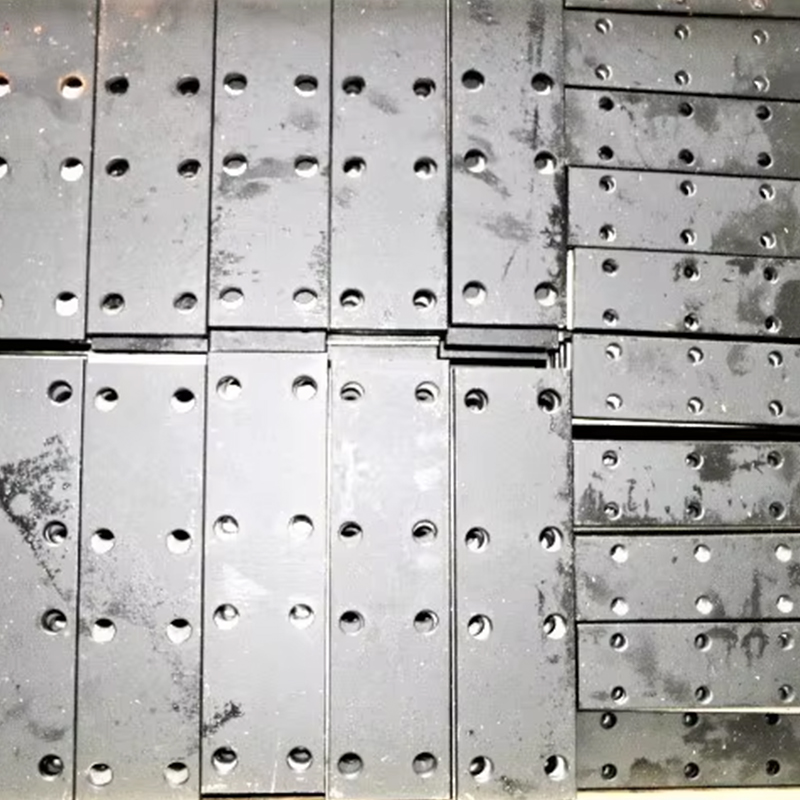
The dimensional accuracy of a fishplate is what makes it an alignment device rather than just a mechanical fastening. The key dimensions that govern fishplate function are tightly toleranced in ISO 7465 and the corresponding national standards.
Correct fishplate installation is a skilled trade operation — an experienced elevator installation technician follows a specific sequence that ensures the rail joint is correctly aligned in all planes before the fishplate bolts are torqued to final specification. Rushing through installation or skipping steps produces the misaligned joints that cause vibration complaints and premature component wear.
Before assembling the fishplate, verify that the fishplate designation matches the guide rail designation — a T90/B fishplate on a T89/B rail will not achieve correct alignment because the profiles are dimensionally incompatible. Check that the rail end faces are square and clean — any burr, scale, or damage on the rail end or back surface will prevent the fishplate from seating correctly. Check that the bolt holes in the rail ends are free of debris and that the threads in the fishplate (if threaded) or the nut bearing faces are undamaged. Inspect the fishplate itself for deformation, cracks, or corrosion damage that would compromise its structural function.
The guide rail must be correctly aligned in both the horizontal (gauge face plane) and vertical (rail head plane) directions before the fishplate bolts are tightened to final torque. The rail support brackets above and below the joint must be correctly positioned and fixed before the joint is assembled. Insert the fishplate bolts and draw them finger-tight only — do not begin torqueing until alignment has been checked and corrected. Use a straightedge or dial indicator across the joint to verify that the blade face is flush within the specified joint step tolerance. Per EN 81-20 and common installation practice, the maximum permitted step at a rail joint (the height difference between adjacent rail blade faces across the joint) is 0.3 mm for standard passenger elevators and tighter for high-speed applications.
The fishplate bolts must be high-strength bolts — ISO property class 8.8 minimum, class 10.9 for heavy-duty applications — and torqued to the manufacturer's specified value in a cross-pattern sequence (similar to wheel nut tightening practice) to ensure even clamping force across all four bolt positions. Typical tightening torques for M12 class 8.8 bolts in standard elevator guide rail fishplates are in the range of 65–80 Nm. Final torque must be applied with a calibrated torque wrench — impact wrenches cannot reliably achieve the specified torque without over- or under-torquing. Under-torqued fishplate bolts allow the joint to flex under dynamic loading, producing joint movement that progressively damages the rail end faces and bolt holes, eventually requiring both fishplate and rail section replacement.
After final torque, re-check the joint step with a straightedge or dial indicator. Mark the bolts with torque-seal or a paint pen for future reference — this allows maintenance personnel to immediately identify any bolt that has backed off during service. Record the joint location, fishplate batch, and installation torque in the elevator maintenance log for traceability. During commissioning, conduct a slow-speed car run past each joint and note any vibration or audible impact that indicates a step or loose joint requiring correction before the elevator enters service.
Elevator fishplates are passive structural components — they do not move, have no wearing parts, and do not require lubrication. Their maintenance requirements are primarily inspection-based: verifying that the bolts remain at specification torque, that no corrosion or damage has compromised the fishplate body, and that the joint alignment remains within tolerance after years of service loading.
Elevator fishplates are safety-critical components and should be sourced from suppliers with appropriate quality credentials. The low unit cost of a fishplate relative to the cost of an elevator maintenance event — or a safety incident attributable to guide rail misalignment — makes quality verification, not price minimization, the correct purchasing priority.
Tel/wechat/whatsapp: +86-13812695057
E-mail: [email protected]
Add: Building 7, No. 268, Chang 'an Road, Bache Sub-district, Dong Taihu Ecological Tourist Resort (Taihu New Town), Wujiang District, Suzhou City, Jiangsu Province, China