

 English
 Español
Industry News
The elevator motor is the heart of any lift system — it is the machine that converts electrical energy into the mechanical torque required to move the elevator car, its passengers, and its counterweight up and down the hoistway. Every ride quality parameter that passengers notice — acceleration smoothness, leveling precision, stopping comfort, and noise level — is directly determined by the performance of the elevator drive motor and its associated control system. A poorly specified or worn motor produces jerky starts, imprecise floor leveling, and mechanical noise that erodes user confidence in the installation and accelerates wear on ropes, guides, and braking components.
For building owners, facility managers, and elevator engineers, the motor selection decision carries consequences that extend well beyond initial installation cost. The elevator hoist motor is the single largest consumer of electrical energy in a typical mid-rise building's lift system, and energy efficiency differences between motor technologies can translate to thousands of dollars per year in operating costs across a multi-elevator installation. The motor type also determines the machine room requirements — or whether a machine room is needed at all — the maintenance intervals, the noise and vibration levels transmitted to the building structure, and the ease of future modernization as drive technology evolves.
The elevator industry has undergone a substantial technology transition over the past three decades, shifting from predominantly geared induction motor drives to gearless permanent magnet synchronous motor (PMSM) systems with variable frequency drives (VFDs). Understanding the full range of available elevator motor technologies — their operating principles, performance characteristics, strengths, and limitations — is essential for making informed decisions about new installations, modernization projects, and maintenance strategies.
Geared vs. Gearless Elevator Motors: The Fundamental Split
The most fundamental classification in elevator motor technology divides drive systems into geared and gearless configurations. This distinction affects almost every aspect of the installation: machine room size, noise level, energy consumption, rope sheave speed, and maintenance requirements.
Geared Elevator Drive Systems
In a geared elevator, the motor shaft drives a worm gear or helical gear reduction unit, which reduces the motor's high rotational speed (typically 900–1,500 RPM for a standard induction motor) down to the low sheave speed (typically 30–100 RPM) needed to drive the hoisting ropes at the correct rope speed. The gear reduction ratio is typically 15:1 to 40:1 for worm gear machines and 5:1 to 12:1 for helical gear units. This configuration allows a relatively small, standard-speed induction motor to develop sufficient torque at the rope sheave through mechanical advantage from the gear ratio. Geared elevator motors are predominantly AC or DC induction motors ranging from 5 kW for small residential lifts to 75 kW for mid-rise commercial elevators with rope speeds up to 2.5 m/s. The primary advantages of geared drives are lower initial cost, use of widely available standard motor components, and compatibility with the building's standard three-phase power supply without requiring specialized inverter drives in older AC two-speed installations.
The disadvantages of geared machines are significant and explain why the technology is declining in new installations. The worm gear unit introduces mechanical losses of 30–50% (worm gears are inherently inefficient), meaning that a geared elevator motor must be considerably larger than its gearless equivalent to deliver the same car-moving power. The gear oil requires monitoring and periodic replacement (typically every 3–5 years), and the worm gear wear surface generates heat and noise that increase over time as the gear mesh degrades. Geared machines also have limited rope speeds — most are not economical above 2.5 m/s — and they typically require a dedicated machine room above the elevator shaft for the gearbox, motor, and control cabinet.
Gearless Elevator Motors
In a gearless elevator drive, the motor shaft is directly coupled to the rope sheave — there is no intermediate gearbox. The motor must therefore operate at the exact low speed required by the sheave (typically 30–100 RPM) while developing very high torque directly at the shaft. This direct-drive configuration eliminates all gear-related mechanical losses, noise, and maintenance, and it is the reason why modern gearless elevator motors achieve overall system efficiencies of 75–90% compared to 45–60% for geared equivalents. Gearless machines are used for rope speeds above 1.0 m/s in mid-rise and high-rise applications and are now also widely deployed in machine-room-less (MRL) low- and mid-rise elevators where the compact motor package is installed directly in the hoistway or on the shaft wall, eliminating the machine room entirely. The gearless design requires either a purpose-built low-speed, high-torque motor (typically a permanent magnet synchronous machine) or a specially designed low-speed induction motor — standard catalogue motors cannot be used without a gearbox because they spin at the wrong speed.
Types of Elevator Motors: A Detailed Breakdown
Within the geared and gearless categories, several distinct motor technologies are used in elevator applications, each with specific performance characteristics, efficiency profiles, and application suitability.
Permanent Magnet Synchronous Motor (PMSM) — The Modern Standard
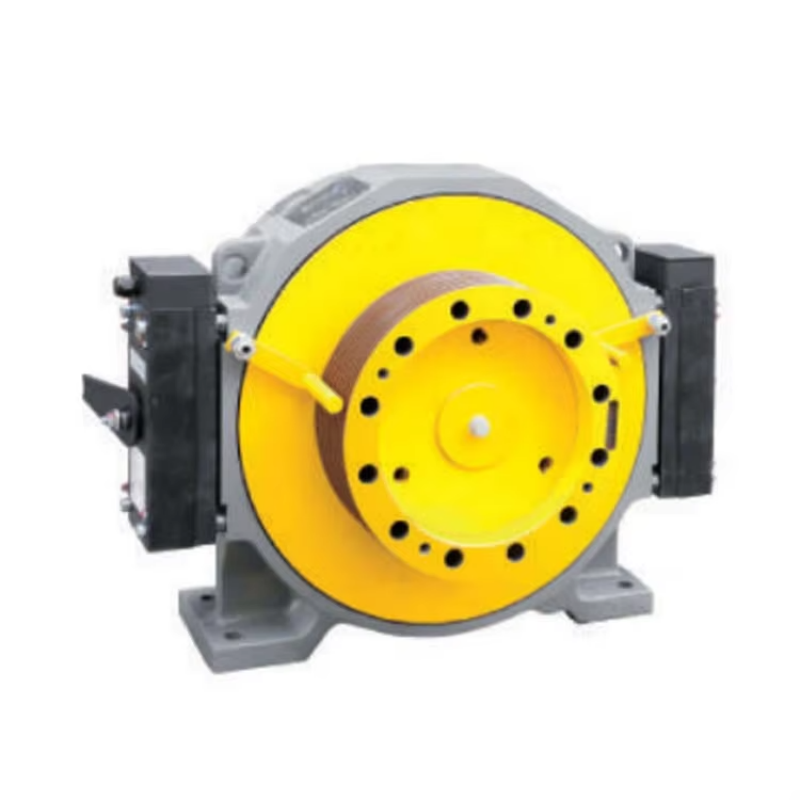
The permanent magnet synchronous motor has become the dominant technology for new elevator installations worldwide, used in the vast majority of MRL and machine-room gearless elevator drives. In a PMSM, the rotor carries permanent magnets (typically neodymium-iron-boron, NdFeB) that create a constant magnetic field without requiring rotor winding current, eliminating rotor copper losses and dramatically improving efficiency. The stator is supplied with variable-frequency, variable-voltage AC power from a dedicated elevator drive inverter (VFD), which precisely controls rotor speed and position using encoder feedback. PMSM elevator motors achieve energy efficiencies of 92–96% at rated load — significantly higher than any induction motor alternative. They are compact and lightweight for their torque output (power density 2–4× higher than equivalent induction motors), operate silently, and allow extremely precise speed and position control for smooth starts, stops, and accurate floor leveling to within ±1–2 mm. The primary limitation of PMSM elevator motors is their dependence on the rare-earth magnets, which add cost and create supply chain considerations, and their requirement for a compatible inverter drive — they cannot be run directly from the supply without a VFD.
AC Induction Motor with Variable Frequency Drive (VFD)
Three-phase AC induction motors controlled by variable frequency drives represent the modern upgraded alternative to older fixed-speed induction motor drives in geared elevator applications, and are also used in some gearless configurations. The VFD adjusts the frequency and voltage supplied to the motor to control its speed continuously, allowing smooth acceleration profiles and precise speed control without the energy-wasting rheostatic or motor-generator speed control systems used in older installations. AC induction elevator motors with VFDs achieve total system efficiencies of 65–80% in geared installations and up to 85% in optimized gearless configurations — significantly better than two-speed AC or Ward-Leonard DC systems they replaced. Their main advantages over PMSM are lower motor cost, no dependence on rare-earth magnets, and the ability to retrofit existing installations more easily since standard motor frames and winding configurations are available from multiple manufacturers without requiring the specialized magnet supply chain of PMSM.
DC Elevator Motors (Ward-Leonard and Thyristor Control)
DC motors controlled by Ward-Leonard motor-generator sets or, later, by thyristor (SCR) rectifier drives dominated high-performance elevator installations from the 1930s through the 1990s. DC series or compound-wound elevator motors provided the excellent low-speed torque, smooth speed control, and dynamic braking characteristics needed for high-speed, high-rise lifts before AC VFD technology matured sufficiently to match their performance. Many older high-rise and premium commercial elevator installations still use DC drive systems that were installed in the 1970s–1990s and continue to perform reliably. DC elevator motors are no longer specified for new installations because AC VFD and PMSM systems have matched or exceeded their performance at lower cost, higher efficiency, and with significantly lower maintenance requirements (DC motors require periodic brush and commutator maintenance that AC motors eliminate entirely). The installed base of DC elevator motors represents a large modernization opportunity for building owners seeking energy savings and reduced maintenance.
Linear Induction Motor (LIM) Elevator Drives
Linear induction motor elevator systems eliminate the rope and sheave entirely, using a flat stator mounted in the hoistway and a reaction rail attached to the elevator car to produce direct linear thrust without any rotating components. LIM elevators are used in specific applications — most notably some observation towers, amusement park rides, and experimental vertical transportation systems — where the absence of ropes and counterweights simplifies the hoistway structure. However, LIM elevators have not achieved widespread commercial adoption in standard building elevator applications due to lower efficiency compared to rope traction systems and complexity of the power bus installation in the hoistway. They remain a niche technology with specific advantages in certain architectural contexts.
Hydraulic Elevator Power Units
Hydraulic elevators use an electric motor to drive a hydraulic pump that pressurizes fluid to extend or retract a piston, moving the elevator car. The motor in a hydraulic elevator power unit is typically a three-phase AC induction motor running at constant speed (1,450 or 1,500 RPM at 50 Hz), driving a fixed or variable displacement hydraulic pump. Motor sizes range from 5 kW for small home lifts to 45 kW for heavy-duty commercial hydraulic elevators. Hydraulic elevator drives are limited to low rise heights (typically 2–6 floors), low speeds (up to 0.63 m/s), and are highly energy-inefficient compared to traction elevator systems — the motor runs at full speed even during descent, with energy dissipated as heat in the hydraulic fluid rather than being recovered. Modern variable-speed hydraulic power units with electronically controlled pump displacement have improved efficiency and ride quality over older fixed-speed systems, but hydraulic elevators remain fundamentally less efficient than traction alternatives and are declining in new installations except for specific low-rise applications where machine room placement below the lift is architecturally advantageous.
Key Technical Specifications of an Elevator Hoist Motor
When specifying or evaluating an elevator motor, a set of key technical parameters defines its suitability for a given application. Understanding these specifications is essential for making accurate comparisons between products and ensuring the selected motor meets both the application demands and regulatory requirements.
| Parameter | Typical Range | What It Determines | Notes |
| Rated Power (kW) | 3–150 kW | Load capacity and speed capability | Sized from load × speed ÷ efficiency × safety factor |
| Rated Torque (N·m) | 200–15,000 N·m | Rope pull force at sheave | Higher torque needed for heavier loads or larger sheave diameter |
| Rated Speed (RPM) | 30–200 RPM (gearless); 900–1,500 RPM (geared) | Car speed via sheave diameter | Must match sheave diameter and rope reeving to give correct car speed |
| Duty Cycle | S3 40–60%, S4, S5 | Thermal capacity and continuous operating capability | IEC 60034 duty classifications; must match expected starts per hour |
| Motor Efficiency | 88–96% (PMSM); 82–92% (induction) | Energy consumption and heat generation | Referenced against IE efficiency classes per IEC 60034-30 |
| Insulation Class | Class F (155°C) or Class H (180°C) | Maximum winding temperature and thermal life | Higher class provides thermal margin in hot machine rooms |
| Protection Rating (IP) | IP23–IP55 | Resistance to dust and moisture ingress | IP54 or IP55 required for outdoor or basement (flooding risk) applications |
| Encoder Resolution | 1,024–65,536 ppr | Speed control precision and floor leveling accuracy | Higher resolution encoder enables better leveling performance |
| Brake Holding Torque | 1.5–2.5× rated motor torque | Safety holding capacity when power is removed | EN 81-20 requires minimum brake torque equal to 125% of rated load torque |
Machine-Room-Less (MRL) Elevator Motors: How Compact Design Changed the Industry
The introduction of machine-room-less elevator technology in the mid-1990s — enabled by the development of compact, high-torque gearless PMSM elevator motors — fundamentally changed elevator installation practice and building design. Before MRL systems, every traction elevator installation required a dedicated machine room, typically located directly above the elevator shaft, containing the traction machine, control panel, and governor. This machine room occupied valuable real estate (typically 10–20 m² per elevator), required structural support capable of carrying the motor and machinery weight, and imposed ceiling height constraints on the top floor of the building.
MRL elevator motors are specifically engineered for installation in the hoistway itself — either on the side wall of the shaft at the top landing, on the underside of the shaft ceiling, or in a shallow overhead structure — without a separate machine room. This is possible because modern PMSM gearless motors have a very flat disc or pancake profile (axial length often less than 300–400 mm even for 15–20 kW machines) and their low operating speed (30–80 RPM) eliminates the need for the large, heavy gearbox that gave traditional machines their bulk. The motor and control system are integrated into compact units that can be installed by standard elevator mechanics without specialized crane equipment in most cases.
The benefits of MRL elevator installations are substantial: elimination of the machine room saves 10–20 m² of net usable floor area per elevator (highly valuable in urban commercial and residential buildings), reduces structural cost by eliminating the need for a machine room floor with crane beam loading capacity, and the compact motor package with VFD drive and energy recovery can reduce energy consumption by 40–70% compared to the older geared AC or Ward-Leonard DC systems they replace in modernization projects. Today, MRL elevators powered by compact gearless PMSM motors account for the majority of new elevator installations in buildings up to approximately 10–15 floors in height, and their technology has been progressively extended upward to serve taller buildings as motor power density continues to improve.
Energy Efficiency and Regenerative Drives in Elevator Motor Systems
Elevator motors are among the largest electrical loads in multi-story buildings, and energy consumption in elevator systems has received growing attention as building energy codes have tightened and the cost of commercial electricity has risen. Understanding the energy performance of different elevator motor and drive configurations helps building owners make informed decisions about new installations and modernization investments.
How Elevator Motors Consume and Recover Energy
An elevator motor acts as a motor during some operational phases and as a generator during others, depending on the direction of car travel and the relative weight of the car plus passengers versus the counterweight. When the elevator moves in the direction of the heavier side (e.g., a loaded car going up, or an empty car going down), the drive motor consumes power from the grid. When the elevator moves against the heavier side (an empty car going up against a heavy counterweight, or a loaded car going down), the motor is essentially being driven by the load — it acts as a generator, producing electrical power. In a conventional non-regenerative drive, this generated energy is dissipated as heat in braking resistors. In a regenerative drive (also called active front-end or energy recovery drive), this generated energy is fed back to the building's electrical distribution system for use by other loads — a process called regenerative braking or energy recuperation.
Energy Savings from Regenerative Elevator Drives
Regenerative elevator drives combined with high-efficiency PMSM motors represent the state of the art in elevator energy performance. The energy recovered during regenerative braking phases — which can represent 20–35% of total motor energy input in a typical duty cycle — is returned to the building grid rather than wasted as heat. Combined with the higher baseline efficiency of a PMSM motor (92–96%) versus an older geared induction motor (45–60% total system), a full PMSM regenerative drive retrofit can reduce elevator energy consumption by 60–75% in buildings with older hydraulic or geared AC two-speed systems. For a typical mid-rise building with 2–4 elevators, this can translate to annual electricity savings of 10,000–30,000 kWh per elevator, representing significant operating cost reduction at current commercial electricity tariffs. Energy consumption testing standards for elevators — including ISO 25745 (Global) and VDI 4707 (German standard that influenced ISO 25745) — provide a standardized framework for measuring and comparing elevator energy consumption across products and installation types.
Standby and Idle Mode Power Consumption
A frequently overlooked aspect of elevator motor energy consumption is standby power — the electricity consumed by the elevator control system, lighting, ventilation, and drive electronics when the elevator is idle (not making a trip). In many commercial buildings, the elevator is actually idle for 60–80% of the 24-hour day, meaning that standby power can represent a significant fraction of total elevator energy consumption. Modern elevator control systems with sleep modes, LED car lighting, demand-controlled ventilation, and low-power standby VFD modes can reduce standby power consumption to as low as 50–100 W per elevator compared to 200–600 W for older systems — a difference that accumulates meaningfully over the elevator's operating life.
Elevator Motor Selection: Matching the Drive to the Application
Selecting the right elevator motor for a specific building application requires a systematic approach that evaluates several interdependent parameters. Getting this right at the design stage prevents both underspecification (inadequate performance, overheating, premature wear) and overspecification (wasted capital cost, poor part-load efficiency).
Calculating Required Motor Power
The minimum required elevator motor power can be calculated from the fundamental equation: P = (Q × g × v) / (η_system × 1000), where Q is the net load (rated car load minus counterweight imbalance, in kg), g is gravitational acceleration (9.81 m/s²), v is the rated car speed (m/s), and η_system is the total drive system efficiency including motor, drive inverter, and sheave/rope friction losses. The counterweight is typically set at the empty car weight plus 40–50% of the rated load, meaning the motor only needs to drive the imbalance between the car plus load and the counterweight rather than lifting the full load weight. For a 1,000 kg rated load elevator at 1.6 m/s with a 40% counterweight imbalance and total system efficiency of 85%, the required motor power is approximately (400 × 9.81 × 1.6) / (0.85 × 1000) ≈ 7.4 kW. A motor of 10–11 kW would then be selected to provide a standard catalogue size with a 30–35% power margin for acceleration, emergency operation, and thermal reserve.
Speed Category and Application Type
The car speed specification is the most important parameter in determining which motor technology is appropriate. As a general guideline: for speeds up to 0.63 m/s (low-rise residential and commercial lifts), hydraulic drives or small geared induction motors with VFDs are common; for 0.63–2.5 m/s (mid-rise commercial and residential), gearless PMSM MRL systems dominate the market; for 2.5–10 m/s (high-rise commercial and mixed-use buildings), larger gearless PMSM machines in conventional machine rooms or penthouse machine rooms are standard; above 10 m/s (supertall buildings), purpose-engineered high-speed gearless machines from specialized manufacturers (Otis, KONE, Schindler, Mitsubishi) are required, often with custom rope configurations, seismic protection features, and active noise damping systems.
Traffic Intensity and Duty Cycle Requirements
The thermal sizing of an elevator drive motor must account for the expected traffic intensity — how frequently the elevator will run in starts per hour and what the on/off duty cycle pattern will be. A residential elevator with 15–30 starts per hour requires a motor with substantially less thermal mass than a high-traffic commercial elevator in an office building during morning peak hour that may reach 120–180 starts per hour. The IEC 60034-1 duty cycle classifications — S3 (intermittent periodic duty), S4 (intermittent periodic duty with starting), and S5 (intermittent periodic duty with starting and electric braking) — are the standard framework for specifying elevator motor thermal requirements. Undersizing the thermal class is one of the most common causes of premature elevator motor winding failure in heavy-traffic installations.
Safety Systems Integrated with Elevator Motors
The elevator motor does not operate in isolation — it is integrated with a set of mandatory safety systems that monitor, control, and limit its operation to ensure passenger safety at all times. Understanding these safety interfaces is essential for both maintenance personnel and modernization engineers.
- Electromechanical Brake: All traction elevator motors are equipped with a spring-applied, electrically released electromagnetic brake that engages automatically when power is removed — whether intentionally at a landing or as a result of power failure, safety circuit interruption, or fault condition. The brake must hold the fully loaded car stationary on any incline without creeping, and must be capable of stopping an overspeed car in conjunction with the governor and safety gear system. EN 81-20 (European standard) and ASME A17.1 (North American standard) specify minimum brake holding torques and require redundant brake circuits on new installations. Brake condition monitoring — measuring brake release current, release time, and disc wear — is increasingly integrated into modern drive controllers as a predictive maintenance tool.
- Speed Governor and Encoder Monitoring: The elevator motor encoder provides continuous speed feedback to the drive controller, which compares actual speed against permitted speed profiles throughout the travel. If the car overspeed threshold is exceeded — typically 115–125% of rated speed — the drive controller initiates an emergency stop sequence. A mechanical centrifugal governor connected to the car via the governor rope provides a secondary, independent overspeed detection system that activates the car's safety gear (progressive or instantaneous type) to clamp the guide rails and bring the car to a controlled stop independent of the motor or drive system.
- Safe Torque Off (STO) and Safety Drive Functions: Modern elevator VFD drives incorporate IEC 61800-5-2 safety drive functions, most importantly Safe Torque Off (STO), which removes the torque-producing voltage from the motor windings without switching off the entire drive — eliminating the hazard of unexpected motor restart after an emergency stop while the drive remains in a monitored safe state. Higher-level safety functions including Safe Stop 1 (SS1) and Safe Speed monitoring (SMS) are increasingly required by EN 81-20 for new installations and are implemented in the drive's safety processor without requiring external safety relays.
- Thermal Protection: Elevator motors are equipped with thermistors (PTC sensors) or PT100 resistance temperature sensors embedded in the stator windings, which continuously monitor winding temperature and signal the drive controller to reduce load or shut down if the thermal limit is approached. This protection prevents insulation damage from sustained overload — for example, a motor running on a high-traffic day during a summer heat wave in a non-air-conditioned machine room. Some modern PMSM elevator motors also monitor magnet temperature to protect against demagnetization at elevated temperatures.
- Unintended Car Movement (UCM) Protection: EN 81-20 introduced the requirement for unintended car movement protection — a system that detects any movement of the elevator car away from a landing with the doors open and activates a stopping device within a prescribed time and distance limit. UCM protection is implemented using the motor encoder for position monitoring combined with a hardware interlock in the drive system that prevents traction force from developing when door open is signaled, with an independent mechanical arresting device as backup.
Elevator Motor Maintenance: What to Inspect and How Often
Proper preventive maintenance of the elevator traction motor is essential for safe operation, legal compliance, and achieving the motor's design service life of 25–40 years for modern PMSM machines. The maintenance schedule and inspection content varies by motor type, traffic intensity, and the requirements of local elevator regulations (which typically mandate periodic inspection by a certified lift engineer regardless of the owner's internal maintenance program).
Routine Monthly and Quarterly Checks
Monthly checks for gearless PMSM elevator motors should include listening for abnormal noises during motor operation (bearing rumble, brake clatter, or resonant vibration), verifying that the motor and brake assembly show no signs of oil or moisture ingress, and checking the motor temperature display or controller log for any thermal events since the last inspection. Quarterly checks should include visual inspection of all electrical cable terminations at the motor junction box for tightness and signs of overheating (discoloration, insulation cracking), verification of brake gap settings against the manufacturer's specification using feeler gauges, and a manual rope inspection at the sheave for rope diameter reduction, wire breaks, or lubricant contamination that could increase sheave wear.
Annual Maintenance Tasks
Annual maintenance of a gearless elevator motor should include insulation resistance testing of motor windings using a 500 V or 1,000 V megohmmeter — minimum acceptable insulation resistance is 1 MΩ per 1 kV of rated voltage, with values below 10 MΩ warranting further investigation and trending. Bearing condition should be assessed by vibration measurement (using a portable vibration analyzer at the motor end shields) and compared to baseline readings taken at commissioning or last bearing replacement. Bearing lubrication — either greasing of the motor bearings per manufacturer's specification (typically 15–25 g of a lithium-complex grease every 2,000–4,000 operating hours) or verification of sealed-for-life bearing condition — should be performed. For geared machines, annual inspection includes gear oil sampling for metal particle analysis (ferrographic testing to detect gear wear before failure), measurement of worm gear backlash against specification, and inspection of the gear housing seal condition.
Signs That an Elevator Motor Needs Replacement
The key indicators that an elevator traction motor has reached end of serviceable life and should be replaced rather than repaired include: insulation resistance consistently below 1 MΩ despite rewinding or treatment (indicating irreversible moisture damage or insulation breakdown), bearing housing bore wear that cannot be corrected without housing replacement, PMSM rotor magnet demagnetization indicated by loss of motor torque constant and confirmed by no-load back-EMF testing, sheave groove wear beyond the manufacturer's wear limit (requiring sheave replacement which often makes whole-machine replacement economical), or a control system that is no longer supported by the manufacturer and for which spare parts are unavailable. In many cases, full machine modernization — replacing the motor, drive, and control system as a package — is more economical over a 15–20 year horizon than repairing an old machine and separately updating the control system, particularly given the energy savings available from modern PMSM drives.
Comparing Major Elevator Motor Technologies Side by Side
For engineers, building owners, and procurement teams evaluating elevator motor options, this comparison table summarizes the key differentiating factors across the main motor technologies in use today.
| Technology | System Efficiency | Machine Room Needed | Speed Range | Maintenance Level | Typical Application | Relative Capital Cost |
| PMSM Gearless + VFD | 80–92% | No (MRL possible) | 0.63–10+ m/s | Low | New installations, all building types | Medium–High |
| AC Induction Gearless + VFD | 72–85% | Usually yes | 1.0–6 m/s | Low–Medium | Mid/high-rise modernization | Medium |
| Geared AC Induction + VFD | 55–70% | Yes | Up to 2.5 m/s | Medium (gear oil) | Low/mid-rise, budget projects | Low–Medium |
| DC Motor (thyristor) | 60–75% | Yes | 0.5–10 m/s | High (brushes, commutator) | Existing legacy high-rise | N/A (legacy only) |
| Hydraulic Power Unit | 25–45% | Yes (below or adjacent) | Up to 0.63 m/s | Medium (fluid, seals) | Low-rise residential, accessibility | Low |
Elevator Motor Modernization: When to Upgrade and What to Expect
The decision to modernize an elevator's drive motor system — rather than continuing to maintain the existing installation — is driven by a combination of factors: increasing maintenance costs, declining ride quality, energy performance that falls short of current building certification requirements, spare parts obsolescence, and changes in safety standards that require compliance upgrades. Understanding the modernization options and their likely outcomes helps building owners make well-informed investment decisions.
- Drive-only modernization (control and inverter replacement): Replacing the elevator controller and drive inverter while retaining the existing motor and machine is the least disruptive and lowest-cost modernization option, suitable when the motor and machine are mechanically sound but the control system is obsolete or unreliable. This approach can improve ride quality significantly (by replacing two-speed contactor control with smooth VFD acceleration profiles) and may reduce energy consumption by 15–25%, but the efficiency gains are limited if the existing motor is a low-efficiency geared induction type.
- Full machine and drive modernization: Replacing the entire traction machine (motor, brake, sheave) along with the drive and control system delivers the maximum performance, efficiency, and reliability improvement. For an existing geared induction motor installation with a machine room, replacing with a PMSM machine and regenerative drive typically achieves 50–70% energy reduction, eliminates gear oil maintenance, reduces noise, and provides 25+ years of additional service life. The cost of this option varies widely by machine size and access difficulty but is typically recovered in energy savings within 5–8 years for commercial buildings with high traffic intensity.
- Machine-room-less conversion: Some modernization projects convert existing machine-room installations to MRL configuration by relocating the new compact PMSM machine into the hoistway — allowing the former machine room to be repurposed as rentable floor space. This conversion is architecturally significant and can generate rental income that substantially accelerates the financial return on the modernization investment, but requires careful structural and hoistway assessment to verify that the guide rail structure can carry the new machine mounting loads.
- Hydraulic-to-traction conversion: Converting an existing hydraulic elevator to a traction (rope-driven) system with a gearless PMSM motor is a more extensive modernization that addresses both the energy inefficiency of the hydraulic drive (system efficiency typically 25–40%) and the environmental liability of the hydraulic oil and cylinder. Traction conversion eliminates the hydraulic cylinder and fluid, increases travel speed capability, and reduces energy consumption by 50–70%. The project involves installing a new overhead machine, guide rails rated for traction loads, a new car frame and counterweight, and complete hydraulic system removal and fluid disposal — a substantial project cost that is typically justified for elevators with significant remaining building life and high traffic intensity.