

 English
 Español

Home / News / Industry News / Deflector Sheave Guide: Types, Groove Wear, Inspection, and Replacement
Industry News

Tel/wechat/whatsapp: +86-13812695057
E-mail: [email protected]
Content
Deflector sheaves rarely get the attention of the traction machine, but they decide how smoothly the ropes run, how evenly they wear, and how quietly the system behaves. In simple terms, a deflector sheave is an idler pulley that changes the direction of the hoist ropes without driving them. It carries the resultant rope load through its bearing, so it must spin freely and hold every rope in the correct plane. When one is worn, misaligned, or fitted with the wrong groove, the symptoms often appear elsewhere: rope vibration, black dust, uneven wear, or a noise complaint that is hard to trace. This guide covers what the part does, how to specify it, and what to check before replacement.
Also called a deflection sheave, return pulley, or guide pulley, it usually sits on the car frame, counterweight frame, or a rope-routing bracket in the machine room or hoistway. Its job is to redirect the rope run between the traction sheave and the car or counterweight, and in some layouts to increase the wrap angle on the traction sheave so there is enough grip. It does not transmit motor torque. That is the key difference from a traction sheave: a deflector sheave is selected for radial bearing load, groove geometry, alignment, and rope fatigue life, not for torque capacity. Smaller deflector pulleys can also guide governor ropes or compensation ropes, but the same rules apply.
The names are sometimes used loosely in the field, so it helps to separate the duties.
| Position | Transmits drive torque? | Typical duty | Selection focus |
|---|---|---|---|
| Traction sheave | Yes | Connected to the motor or gearbox; pulls the hoist ropes | Torque, groove profile, wrap angle, braking |
| Deflector sheave | No | Redirects rope run or increases wrap angle | Bearing load, alignment, groove pitch, diameter |
| Counterweight sheave | No | Guides and redirects ropes at the counterweight | Load rating, guard clearance, bearing, rope retention |
A counterweight sheave is often a type of deflector sheave. What matters is the drawing: whether the rim is grooved, how many ropes it carries, where the load path goes, and whether the part is guarded.
Most deflector sheaves we handle are cast iron or nylon. Cast iron is the traditional choice for robust, heavy-duty layouts and remains easy to repair or replace in kind. Nylon sheaves are lighter, quieter, and can reduce wear on the rope in some passenger-elevator layouts, but the load rating, temperature, and bearing arrangement need to be checked. Steel rims appear in special or high-load applications. Groove profile matters as much as material. A groove that is too narrow pinches the rope; one that is too wide reduces support; a worn groove creates point loading and accelerated rope wear. Common profiles include U-groove, V-groove, and undercut or round-groove variants. On a deflector sheave, the groove is mainly a guide, but it still has to match rope diameter and pitch.
 Custom Nylon Elevator Deflector Sheave VTSP274View this custom nylon deflector sheave for counterweight-frame layouts where weight and noise matter, with stated 240–640 mm diameter and 2–10 slots.View Product →
For counterweight-frame layouts where weight and noise matter, a nylon deflector sheave is often a practical starting point. The outside diameter should still be large enough for rope fatigue life. A small sheave saves space but increases bending stress in the ropes. Multi-rope units must have consistent groove pitch; if the pitch is uneven, the ropes will fight the alignment. Bearings may be sealed ball, roller, or bushed depending on load and speed. Guards and retaining flanges are functional parts, not decoration - they keep ropes in place when tension momentarily drops.
When a customer sends a photo and asks for “the same one,” we usually need a few more details before we can quote with confidence.
A worn sample can hide the original dimensions. Measure an unworn section or reconstruct the data from the rope group and center distance. If the job is a modernization, check whether the existing rope size will stay. Changing sheave diameter without checking rope ratio, rope tension, and alignment can create a new problem while solving an old one. Where the rope run needs a different diameter, a tension deflector pulley made to the layout is often the cleanest solution.
 VTSP273 Tension Deflector Pulley Sheave, Different DiametersCheck this tension deflector pulley when a rope run needs a different diameter, with listed 240–640 mm range, 2–10 slots, and 6.5–13 rope size.View Product →
A deflector sheave usually gives warning before it fails. Listen for a rhythmic tick, whine, or rumble that changes with car speed. Look for rope fuzz, flattened rope, shiny groove edges, groove depth steps, and black dust around the bearing. Check bearing play with the rope unloaded where the procedure allows, and look for grease weeping or overheating. A sheave that has lost its groove profile can wear ropes quickly; a rope that has jumped a flange is a serious safety issue and should be investigated before the lift returns to service. We keep a more detailed walkthrough of elevator pulley types, groove profiles, and replacement tips in our industry notes.
Replacing a deflector sheave is not just unbolting the old one and fitting the new one. The rope group has to be supported correctly, and the alignment has to be checked after the part is in place.
Keep the old part until the new one has run for a while. If the old groove was worn unevenly, check bracket alignment rather than blaming the sheave alone. In modernization work, a new sheave can reduce noise through a different bearing or rim material, but do not mix materials within a rope group without checking compatibility and load.
VITIN supplies elevator sheaves and traction-system parts for new builds, spare-parts stock, and modernization projects. Our range includes cast iron and nylon deflector sheaves, counterweight sheaves, and tension pulleys in standard and custom diameters. Because we work with both elevator manufacturers and service companies, we are comfortable quoting from a drawing, a sample, or a complete rope layout. We will ask about rope size, groove count, bearing type, and mounting pattern before we release a quote; that saves a second round of questions later. Our quality process is built around ISO 9001 discipline, and we can discuss material and dimensional records for the order. If you want to see how we inspect and pack sheaves, you are welcome to arrange a factory visit.
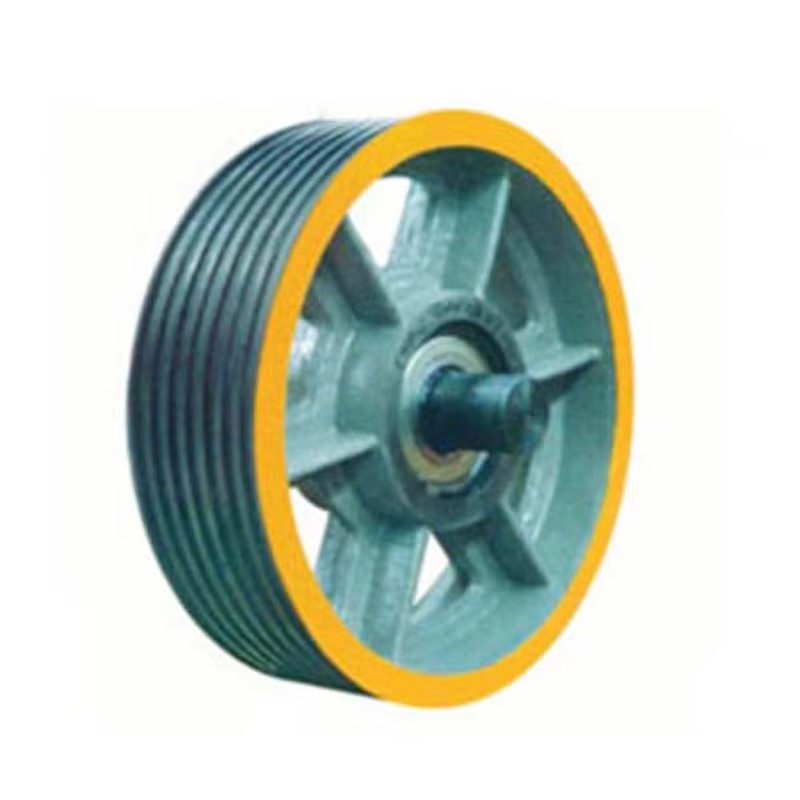 VTSP269 Elevator Guiding Deflecting Pulley SheaveReview this custom guiding-deflecting pulley sheave for elevator traction layouts, with stated 240–640 mm diameter, 2–10 slots, and 6.5–13 rope range.View Product →
Before you order, put the old sheave on the bench and answer five questions: What is the rope diameter and groove pitch? How many ropes does the sheave carry? Is the bearing still available as a separate part? What is the center distance and mounting offset? Will the new part clear the existing guard? A deflector sheave is a small component with a large influence on rope life and ride quality. Get those details right, and it will disappear into the system - which is exactly what a good idler pulley should do.



Tel/wechat/whatsapp: +86-13812695057
E-mail: [email protected]
Add: Building 7, No. 268, Chang 'an Road, Bache Sub-district, Dong Taihu Ecological Tourist Resort (Taihu New Town), Wujiang District, Suzhou City, Jiangsu Province, China